Your doctor said something like, “Let’s freeze these embryos from this cycle and transfer them next month.” Your instinct says that sounds like a delay, why wait when you could transfer now, while everything’s already in motion?
It’s a fair question, and the honest answer is that waiting isn’t a compromise – in many cases, it’s often the better move, backed by real evidence rather than convenience for the clinic.
Why Clinics Freeze Instead of Transferring Fresh
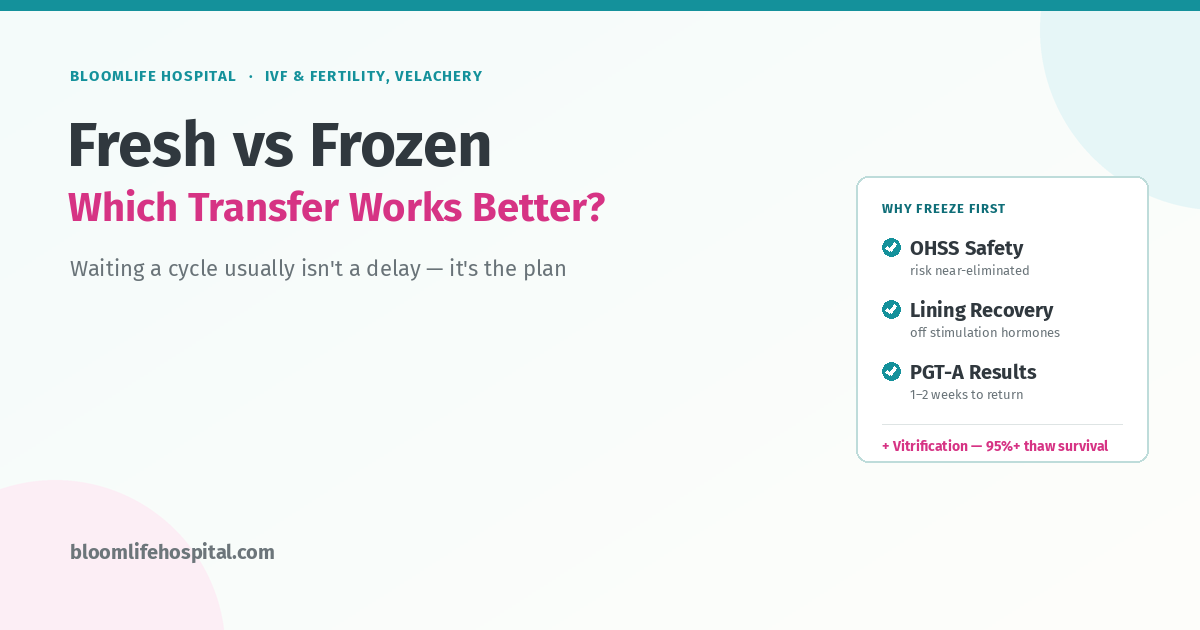
OHSS safety. Ovarian stimulation raises hormone levels sharply, and in women who respond strongly, particularly those with PCOS, this can trigger ovarian hyperstimulation syndrome. Freezing all embryos and transferring later, once hormone levels have settled, removes this risk almost entirely rather than managing it during an active pregnancy.
Endometrium recovery. Here’s the part that surprises most people. The same stimulation medications that grow multiple eggs also change the uterine lining in ways that can make it less receptive to an embryo right at that moment, even though it looks normal on a scan. Giving the body a cycle to return to its natural hormonal state before transfer can improve the chances of implantation.
Waiting on PGT results. If you’re doing genetic testing on your embryos, results take roughly 1 to 2 weeks, well past the window for a fresh transfer. Freezing while you wait is a practical necessity here.
Better cycle timing. Freezing also lets your clinic choose the optimal timing for transfer based on your own natural or medicated cycle, rather than being locked into whatever day retrieval happened to land on.
Fresh vs Frozen, the Evidence Compared
| Fresh Transfer | Frozen Transfer (FET) | |
| Success rate | Comparable in normal responders, frozen edges ahead in some larger studies | Equal or higher, particularly in high responders and PCOS patients |
| OHSS risk | Real risk in high responders | Near elimination |
| Flexibility on timing | None, transfer happens within the stimulation cycle | High, transfer can be scheduled around your body and life |
| Cost | Included in the base IVF cycle | Additional freeze and thaw cost, though avoids a full repeat cycle |
| Time to pregnancy | Faster if successful first attempt | Adds roughly one menstrual cycle before transfer |
The honest framing, since this genuinely isn’t universal: A large UK trial (E-Freeze) found no statistically significant difference in healthy baby rate between elective freeze-all and fresh transfer in normal responders, meaning for many patients, neither approach is definitively “better,” they’re comparable options with different trade-offs. Where frozen pulls ahead more consistently is in high responders and PCOS patients specifically, where OHSS prevention alone can justify the wait, and in cases using PGT-A, where selecting a genetically normal embryo before transfer measurably improves outcomes.
The FET Process, Step by Step
Cycle type. Your clinic will use either a natural cycle, tracking your own ovulation, or a medicated cycle, using hormone tablets or patches to prepare the lining on a controlled schedule. Medicated cycles offer more predictable timing, natural cycles avoid extra medication, your doctor will recommend one based on your cycle regularity.
Lining preparation. Whichever approach, the goal is a uterine lining of adequate thickness, generally around 7mm or more, before transfer proceeds. This is checked by ultrasound over several visits leading up to transfer day.
Thaw. Embryos frozen using vitrification, today’s standard flash-freezing method, survive the thaw at very high rates, modern published data cites figures often exceeding 95%, a dramatic improvement over older slow-freezing methods from a decade or more ago.
Transfer day. The thawed embryo is transferred in a short outpatient procedure, similar to a fresh transfer, typically without sedation, taking only a few minutes.
Are Frozen Embryo Babies Healthy
This is usually the real question underneath all the process details, and it deserves a direct answer. Yes. Long-term outcome studies comparing children born from frozen versus fresh embryo transfer have found no meaningful difference in major health outcomes, and some data even shows slightly higher average birth weights in FET babies, likely related to the more natural hormonal environment at implantation rather than any risk from freezing itself.
The technology behind this reassurance matters too. Older slow-freezing methods, used until roughly the mid 2000s, did carry more risk of ice crystal damage to embryos. Vitrification, the ultra-rapid freezing method used today, essentially eliminates that risk by cooling embryos so quickly that damaging ice crystals never form. This is the single biggest reason frozen transfer outcomes have improved so dramatically over the past 15 years.
Cost and Practicalities
An FET cycle is generally less expensive than a full fresh IVF cycle, since it skips the stimulation medication and egg retrieval, the two higher cost components. Stodrage fees apply for keeping embryos frozen, typically billed annually, and embryos can safely remain frozen for years without meaningful degradation, verified pregnancies have resulted from embryos stored for well over a decade. For the fuller cost picture, our IVF and FET costs breakdown covers where each component fits.
As Dr. Kavitha Gautham explains, “Patients often ask me if freezing means their cycle ‘didn’t work’. I explain that freezing is frequently the plan working exactly as intended, not a fallback, especially when we’re protecting against OHSS or waiting on genetic testing results that will actually improve the odds of the transfer that follows.”
How BloomLife’s Team Approaches This
Our embryology lab uses vitrification for all embryo freezing, and we make the fresh versus freeze-all decision on a per-patient basis during your stimulation cycle, based on your hormone response and risk profile, not as a default policy applied to everyone. If a previous transfer didn’t result in pregnancy, our guide on what typically happens after failed transfers covers the review process, and our piece on blastocyst culture explains how day 5 embryo development connects to freezing decisions.
To discuss whether fresh or frozen transfer suits your specific cycle, explore IVF and embryo freezing in Chennai at BloomLife Hospital or call 72999 11102.
Frequently Asked Questions
1. Is frozen embryo transfer better than fresh?
Not universally, outcomes are comparable in normal responders, and frozen transfer is more consistently favourable for high responders, PCOS patients, and anyone using PGT-A testing, since it avoids OHSS risk and allows the uterine lining to recover from stimulation medication first.
2. What is the success rate of FET?
Published research generally shows frozen transfer success rates matching or slightly exceeding fresh transfer, particularly with vitrified blastocysts and in higher responding patients.
3. How is the FET cycle done?
Either a natural cycle, tracking your own ovulation, or a medicated cycle using hormone medication prepares your uterine lining ahead of transfer. Once the lining reaches adequate thickness, the frozen embryo is thawed and transferred in a short outpatient procedure.
4. Are babies from frozen embryos healthy?
Yes, long-term studies show no meaningful difference in major health outcomes between children born from frozen versus fresh embryo transfer, and some data shows slightly higher average birth weights in FET babies.
5. How much does FET cost compared to a full IVF cycle?
FET is generally less expensive than a full cycle since it skips stimulation medication and egg retrieval, though storage fees and thaw costs apply on top of the transfer itself. The actual cost is best checked with our IVF consultants over a detailed discussion at our hospital.