A doctor. A friend who froze her eggs. An Instagram post.
Or someone just told you to get an AMH test done, and now you’re holding a number with no real sense of what it means for YOU specifically.
Here’s what the AMH test actually measures, the real age chart, what your number does and doesn’t tell you, and whether a low result should change any of your life plans.
What the AMH Test Actually Measures
AMH or anti Müllerian hormone, is produced by the small, developing follicles in your ovaries. The level in your blood works as a proxy for your ovarian reserve, roughly how many eggs remain, not how many you started with, and not how healthy those remaining eggs are.
AMH measures quantity, not quality. Egg quality is driven mainly by age, not by your AMH level. This is also why AMH doesn’t reliably predict your chances of conceiving naturally. A landmark study following women aged 30 to 44 trying to conceive found no meaningful difference in natural conception rates between women with low AMH and women with normal AMH, provided they were still ovulating regularly. Where AMH genuinely matters is in predicting how your ovaries will respond to IVF stimulation, since that depends directly on how many follicles are available to work within a given cycle.
The Age Wise Chart
Here’s a general reference range. Treat this as orientation, not a pass or fail score, individual variation is substantial, two women of the same age can have AMH values that differ several fold and both still be entirely normal. Labs and assay platforms also vary, so always interpret your result against your own lab’s reference range.
| Age | Typical AMH Range (ng/mL) | General Interpretation |
| Under 25 | 3.0 to 7.0 | Typically high reserve |
| 25 to 30 | 2.5 to 6.0 | Normal to high reserve |
| 30 to 35 | 1.5 to 4.0 | Normal reserve |
| 35 to 40 | 0.7 to 3.5 | Normal, trending toward lower reserve |
| Over 40 | 0.3 to 1.5 | Lower reserve, expected for age |
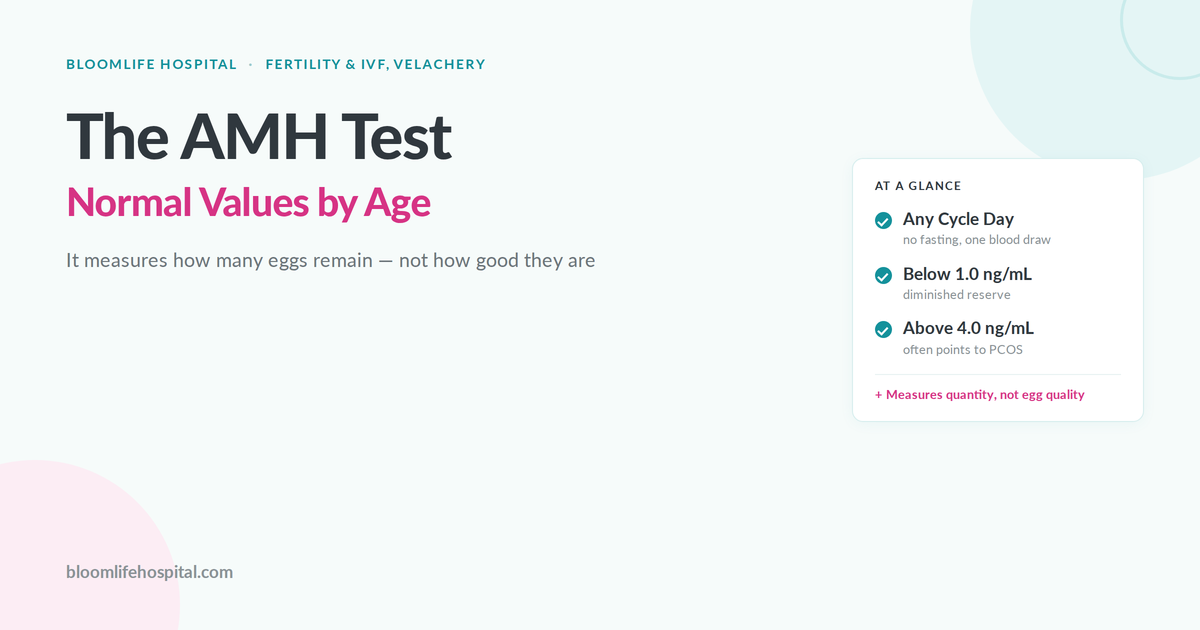
Most fertility specialists consider AMH below roughly 1.0 to 1.2 ng/mL as indicating diminished ovarian reserve for reproductive age women generally, though what counts as low genuinely depends on your specific age, since 1.2 ng/mL is an entirely different signal at 28 than it is at 41.
Taking the Test
The AMH test can be done on any day of your cycle, unlike several other fertility hormone tests that need specific cycle timing. No fasting is required. It’s a simple blood draw with results typically available within a day or two.
Cost in Chennai generally runs between roughly ₹1,600 and ₹3,000 depending on the lab, with premium panels that bundle AMH alongside other fertility hormones, FSH, LH, TSH, and prolactin, priced somewhat higher.
You can book fertility testing in Chennai directly with us rather than a standalone lab, so your result gets interpreted by a fertility specialist alongside your full picture, not handed to you as an isolated number.
Low AMH, What It Actually Signals
A low AMH result is a planning signal, not a verdict. It changes urgency, not possibility. At 32 with a low reading, the conversation is different than at 40 with the same number, mainly because age itself, independent of AMH, is the bigger factor in egg quality and natural conception odds.
Natural conception generally remains possible with low AMH, since you only need one good egg released each cycle, and low reserve doesn’t mean the eggs you do have are unhealthy. Where low AMH changes things more directly is IVF, since a lower reserve typically means fewer eggs retrieved per stimulation cycle, which can mean your doctor uses a different protocol or adjusts expectations around how many embryos a single cycle might produce. If you’re not planning to try immediately, egg freezing is worth discussing specifically because it locks in your current reserve rather than waiting through further natural decline. Our guide on how to increase AMH levels covers what genuinely helps and what doesn’t if you’ve received a low result.
High AMH, the Section Most Posts Skip
A high AMH result, generally above 4.0 to 5.0 ng/mL, is worth understanding just as much as a low one, and most articles skip it entirely. High AMH is commonly associated with PCOS, since PCOS involves many small follicles that each contribute to the overall AMH level, without necessarily meaning easier ovulation, since the issue with PCOS is often irregular egg release, not egg supply.
The other reason a high result matters: If you go through IVF stimulation, a high AMH raises your risk of ovarian hyperstimulation syndrome, since your ovaries are likely to respond strongly to stimulation medication. This isn’t a reason to avoid IVF; it’s a reason your doctor will likely use a more conservative stimulation protocol specifically to manage that risk, rather than treating your case identically to someone with average AMH.
Who Should Test, and When
AMH is worth testing for if you’ve been trying to conceive for over a year without success, if you’re 35 or older and considering your fertility timeline, if there’s a family history of early menopause, before pursuing egg freezing specifically to understand what you’re working with, or as part of a broader PCOS workup alongside other hormone tests.
How BloomLife Hospital’s Team Approaches This
At BloomLife Hospital, an AMH result is never handed over as a standalone number. It’s interpreted alongside your age, cycle history, and, where relevant, an ultrasound antral follicle count, since AMH in isolation tells an incomplete story either way, too reassuring on its own if high, too alarming on its own if low.
If you’ve been handed an AMH number with no real explanation of what it means for you, that conversation is worth having properly. Book fertility testing in Chennai or call 72999 11102, and get your result interpreted in context rather than googled at midnight.
If IVF is part of your path forward, read through our guide on IVF treatment in Chennai for better understanding.
Frequently Asked Questions
1. What is the AMH test for?
The AMH test measures anti Müllerian hormone, a marker of ovarian reserve, roughly how many eggs remain. It’s used to help plan fertility timelines, predict how your ovaries might respond to IVF stimulation, and as part of a PCOS workup, though it does not measure egg quality or reliably predict natural conception chances.
2. What is a normal AMH level by age?
Normal ranges decline with age, roughly 3.0 to 7.0 ng/mL under 25, 1.5 to 4.0 ng/mL in your early 30s, and under 1.5 ng/mL past 40. Individual variation is substantial, so these ranges are a general guide, always interpreted alongside your specific lab’s reference range and your own clinical picture.
3. What AMH level is needed to get pregnant?
There isn’t a specific AMH threshold required for pregnancy, since AMH doesn’t reliably predict natural conception ability. Studies have found women with low AMH conceive naturally at similar rates to women with normal AMH, provided they’re ovulating regularly, egg quality and age matter more than the AMH number itself.
4. Does low AMH mean I cannot conceive?
No. Low AMH means a lower egg quantity, not necessarily poor egg quality or an inability to conceive. Natural conception often remains possible, since only one healthy egg is needed per cycle. Low AMH mainly changes IVF planning, since it typically means fewer eggs retrieved per stimulation cycle.
5. What is the cost of an AMH test in Chennai?
AMH testing in Chennai generally costs between roughly ₹1,600 and ₹3,000 depending on the lab and whether it’s bundled with other fertility hormones. Booking through a fertility clinic rather than a standalone lab means your result gets interpreted alongside your full clinical picture.