
Medically Reviewed By
Dr. K. S. Kavitha Gautham
MBBS, MS (OG), DRM (Germany), FIMSA, FICOG · Senior Consultant & Managing Director, BloomLife Hospital
Dr. Kavitha Gautham is a fertility specialist and obstetrician-gynaecologist with over two decades of experience and more than 5,000 IVF cycles. She leads the Reproductive Medicine & Fertility Centre at BloomLife Hospital, Velachery.
View full profile →Your period is 9 days late, your home test says negative, and you’re stuck cycling between two feelings that don’t fit together. You’re worried that something is seriously wrong, and confused since the test says ‘no’. Here’s a clear answer on the maximum delay in periods if not pregnant, what actually causes it, and exactly when it’s time to see a doctor rather than wait it out.
How Late Is Actually Normal
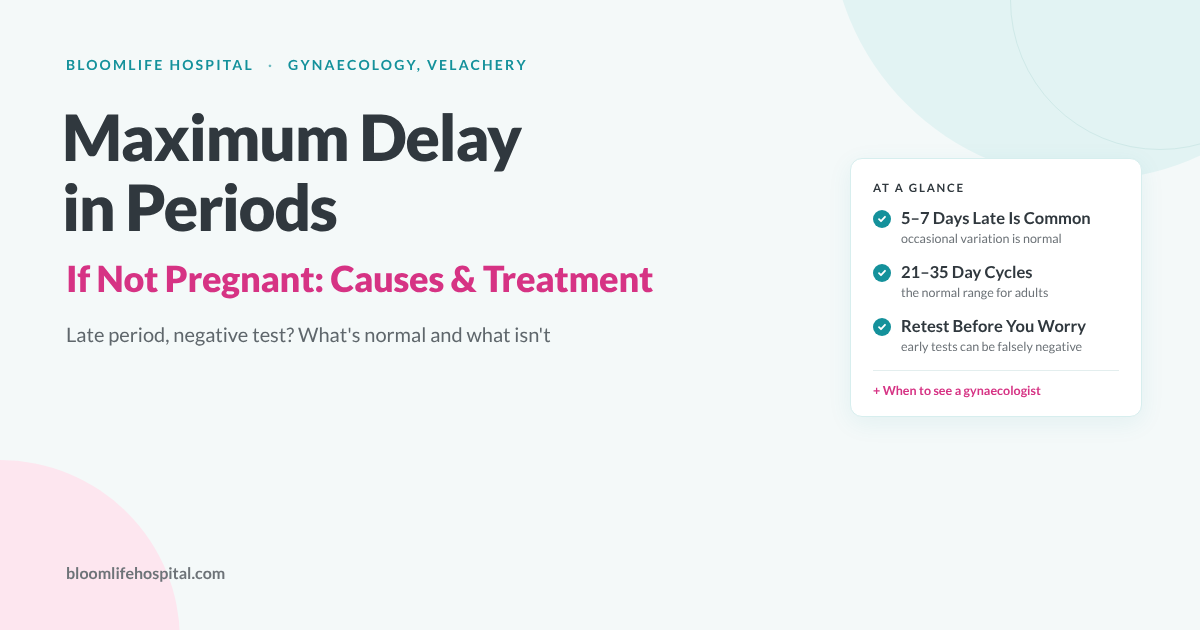
Cycle length varies more than most people realise, even in perfectly healthy women. A cycle running anywhere from 21 to 35 days is considered within normal range, and a delay of 5 to 7 days beyond your usual pattern happens occasionally to most women and isn’t automatically a concern.
Where does it start counting as a genuinely missed period? Beyond 7 to 10 days late with a negative pregnancy test, or a pattern of cycles repeatedly stretching past 35 to 40 days. One irregular cycle rarely means anything on its own, your body has months off for all sorts of reasons, such as travel, illness, and a stressful work deadline. It’s the repeated pattern, three or more irregular cycles in a row, that’s worth a proper look rather than a single late month.
First, Rule Out Pregnancy Properly
Home pregnancy tests are accurate from the first day of your missed period in most cases, but timing matters more than people realise. Testing too early, before your period is even due, can produce a false negative simply because hCG hasn’t risen high enough yet to detect. If your period is late and a home test is negative, retesting a few days later, or with your first morning urine, gives a more reliable result than a single test taken at the wrong time of day.
If you need a definitive answer sooner, a blood test for hCG at any clinic or lab gives a more sensitive result than a home urine test and can detect pregnancy earlier and more reliably.
The Real Causes Beyond Pregnancy
Stress. Can stress delay periods by 10 days or more? Genuinely, yes. Cortisol, your body’s main stress hormone, directly interferes with the signals that regulate ovulation. This tends to feel like a cycle that’s simply late with no other symptoms, often following an identifiably stressful stretch, exams, a family situation, a major deadline.
PCOS. One of the most common causes of irregular, unpredictable cycles, sometimes stretching to 45 days or longer, sometimes skipping months. Often comes with other signs, acne, unwanted hair growth, or weight changes, though not always.
Thyroid issues. Both an underactive and overactive thyroid can disrupt your cycle. Underactive thyroid tends to feel like fatigue, weight gain, and feeling cold alongside the delay. Overactive thyroid tends to feel like anxiety, weight loss, and a racing heartbeat alongside cycle changes.
Sudden weight change or over exercise. Significant weight loss, weight gain, or a sharp increase in exercise intensity can all suppress the hormonal signals needed for a regular cycle. This tends to feel like a cycle that shifted noticeably after a specific change in diet or training, not a random surprise.
Perimenopause. For women in their early to mid-40s, increasingly irregular cycles can be an early sign of the transition toward menopause, often alongside hot flashes or sleep changes.
Breastfeeding. Prolactin, the hormone that supports milk production, actively suppresses ovulation, which is why cycles often stay absent or irregular through a significant part of breastfeeding.
Certain medications. Hormonal contraceptives, some antipsychotics, and certain blood pressure or thyroid medications can all affect cycle regularity as a side effect. Worth checking with whoever prescribed it if a new medication lines up with a new pattern of delay.
Elevated prolactin, unrelated to breastfeeding. Some women have naturally elevated prolactin levels outside of breastfeeding, sometimes linked to a small, usually benign pituitary growth. This tends to feel like irregular cycles alongside unexpected breast discharge, worth mentioning specifically to your doctor.
Chronic illness. Poorly controlled diabetes, celiac disease, and other chronic conditions can all disrupt cycle regularity as part of their broader effect on the body.
Coming off hormonal birth control. It’s common for cycles to take a few months to find their own rhythm again after stopping the pill or another hormonal method, this is usually temporary rather than a sign of an underlying problem.
When to See a Gynaecologist
A few clear thresholds worth acting on rather than waiting through.
- Three missed cycles in a row, even without other symptoms.
- Cycles repeatedly run beyond 35 to 40 days over several months.
- Irregular cycles alongside other symptoms such as new hair growth, acne, unusual discharge, or pelvic pain.
And if you’re actively trying to conceive, irregular cycles are worth addressing sooner rather than waiting the full year typically recommended before a fertility evaluation, since identifying the cause faster means starting treatment earlier too.
What the Doctor Will Actually Do
The workup is more straightforward than it might sound. A detailed history first, your cycle pattern, any other symptoms, medications, stress, and weight changes. This is followed by a physical exam where a hormone panel, typically including thyroid function, prolactin, and reproductive hormones is tested to identify which of the causes above actually applies to you. Additionally, an ultrasound is mainly used to check for PCOS related findings or other structural causes.
Treatment matches the actual cause rather than defaulting to a single universal pill. Thyroid dysfunction gets thyroid medication. PCOS gets a combination of lifestyle changes and, if needed, medication to regulate cycles or address insulin resistance. Stress related delay often resolves once the underlying stressor eases, sometimes with support for managing it better in the meantime. There isn’t one treatment for irregular periods in general, there’s a treatment for whatever is actually causing yours.
How BloomLife Hospital’s Team Approaches This
At BloomLife Hospital, a late period with a negative test starts with a proper history and hormone panel, not a guess or a generic prescription. Most causes on the list above are entirely manageable once correctly identified, and many resolve completely with the right treatment.
If you’ve been stuck in this exact limbo, worried on one hand and confused by a negative test on the other, that’s precisely the situation worth a proper consultation rather than more waiting. Consult a gynaecologist or call 72999 11102.
If discharge changes have accompanied your cycle irregularity, our guide on white discharge before period is worth reading alongside this one, and if fertility is also a concern, our piece on increasing AMH levels naturally covers the ovarian reserve side of the picture.
Frequently Asked Questions
What is the maximum delay in periods if not pregnant?
A delay of 5 to 7 days beyond your usual cycle length is common and not automatically concerning. Beyond 7 to 10 days late with a negative pregnancy test, or a repeated pattern of cycles beyond 35 to 40 days, is worth discussing with a gynaecologist to identify the underlying cause.
How many days late is normal for a period?
Up to about 5 to 7 days late occasionally is within normal cycle variation for most women, since cycle length naturally ranges from 21 to 35 days even in healthy women. A single late cycle rarely means anything on its own, it’s a repeated pattern that’s worth evaluating.
Why is my period late if the pregnancy test is negative?
Common reasons include stress, PCOS, thyroid dysfunction, sudden weight change, over exercise, breastfeeding, certain medications, and coming off hormonal birth control. A negative test taken too early can also be a false negative, worth retesting a few days later to confirm.
Can stress delay periods by 10 days?
Yes, genuinely. Cortisol directly interferes with the hormonal signals that regulate ovulation, and a significantly stressful stretch, exams, a major life event, intense work pressure, can delay a period by a week or more without any other underlying cause.
When should I see a doctor for a late period?
See a gynaecologist after three missed cycles in a row, if cycles repeatedly run beyond 35 to 40 days, if irregularity comes with other symptoms like new hair growth or acne, or immediately if you’re actively trying to conceive, since earlier evaluation means earlier treatment.