
Medically Reviewed By
Dr. K. S. Kavitha Gautham
MBBS, MS (OG), DRM (Germany), FIMSA, FICOG · Senior Consultant & Managing Director, BloomLife Hospital
Dr. Kavitha Gautham is a fertility specialist and obstetrician-gynaecologist with over two decades of experience and more than 5,000 IVF cycles. She leads the Reproductive Medicine & Fertility Centre at BloomLife Hospital, Velachery.
View full profile →You’re holding a semen analysis report with more numbers and percentages on it than you expected, and one value is flagged in red. Nobody at the lab explained what it means, they handed you a printout and moved on to the next patient. Let’s go through it line by line, the way we would if you were sitting across from us instead of googling at midnight.
How the Test Actually Works
A semen analysis is done after 2 to 5 days of abstinence, not longer, not shorter, since both extremes can skew results away from your true baseline. The sample is collected by masturbation into a sterile container, either at the lab or at home if you can deliver it within the lab’s specified window, and analysed under a microscope shortly after.
Here’s what matters most before you look at a single number. Conditions on the day genuinely affect results. A fever in the preceding 2 to 3 months, since sperm takes that long to develop, recent illness, excessive heat exposure like a long drive or a hot tub, high stress, even a longer than usual gap since your last ejaculation, can all shift a single sample’s numbers meaningfully. One report, taken under less than ideal conditions, tells you less than most people assume.
Your Report, Decoded Line by Line
| Parameter | What It Measures | WHO 2021 Normal Range | What Low Means |
| Volume | Total semen produced per sample | 1.4 ml or more | Possible incomplete collection, retrograde ejaculation, or ductal blockage |
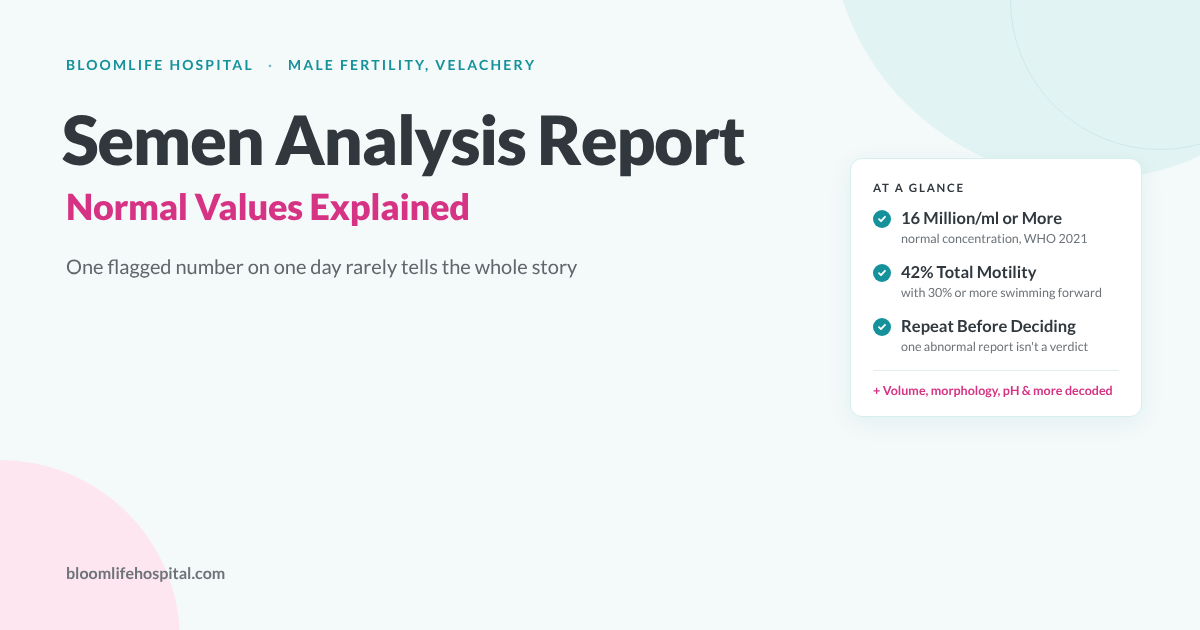
| Concentration | Sperm per millilitre | 16 million/ml or more | Oligospermia, fewer sperm available to reach the egg |
| Total sperm count | Concentration × volume, sperm per ejaculate | 39 million or more | Combines volume and concentration issues into one number |
| Progressive motility | % of sperm swimming forward purposefully | 30% or more | Sperm may struggle to travel the distance to fertilise an egg |
| Total motility | % of sperm moving at all, forward or not | 42% or more | Broader movement issue beyond just forward swimming |
| Morphology | % of sperm with normal shape | 4% or more | Abnormally shaped sperm fertilise less efficiently |
| Vitality | % of live sperm in the sample | 54% or more | Distinguishes dead sperm from live sperm that simply aren’t moving |
| pH | Acidity or alkalinity of semen | 7.2 or higher | Low pH combined with low volume can suggest a ductal blockage |
| Liquefaction | Time for the sample to change from gel to liquid | Within 15 to 60 minutes | Delayed liquefaction can interfere with sperm mobility in the sample |
A genuinely important number that gets overlooked: Total sperm count (39 million per ejaculate) is often more clinically meaningful than concentration alone, since two men with identical concentration per millilitre can have very different total counts if their semen volume differs. Your doctor will usually weigh total count over concentration in isolation.
One Abnormal Report Is Not a Verdict
This part confuses most people, and it’s worth stating as clearly as possible.
Semen parameters vary naturally between samples from the same man, sometimes significantly, due to the factors mentioned above. A single result below WHO reference values is not a diagnosis of infertility, and the WHO’s own reference values are the 5th percentile of a fertile population, meaning a meaningful proportion of men who go on to father children naturally fall below at least one of these numbers at some point.
The standard, sensible next step is a repeat test 2 to 4 weeks later, ideally under better conditions, no recent illness, standard abstinence window, less stress if possible. If two consecutive tests show the same pattern, that’s when the result starts to mean something clinically, one flagged value on one report rarely does.
Common Patterns, and What They Suggest
Low count (oligospermia). Concentration below 16 million/ml. Often addressable through lifestyle changes if mild, and worth investigating for underlying causes like varicocele or hormonal imbalance if more pronounced.
Low motility (asthenospermia). Sperm present in adequate numbers but not swimming effectively. Sometimes linked to infection, heat exposure, or oxidative stress, and often responds to the same lifestyle interventions that help count.
Zero sperm (azoospermia). No sperm detected even after centrifugation of the sample. This is a distinct and more serious finding that needs its own dedicated workup — our guide on azoospermia explains what this specifically means and the treatment paths available, since zero sperm in the ejaculate doesn’t necessarily mean zero sperm production.
Combined patterns. Many reports show more than one parameter low at once, low count alongside low motility is common, and typically points toward a broader underlying factor, hormonal, structural, or lifestyle related, rather than several unrelated issues.
Each pattern has a typical next step, ranging from a simple repeat test and lifestyle changes for mild findings, to hormonal bloodwork and a specialist consultation for more significant or combined patterns.
What Improves the Numbers
Since sperm regenerates continuously, roughly every 64 to 74 days for a full cycle, changes made today have a real window to show measurable improvement, typically visible on a repeat test around 3 months later. Our guide on how to increase sperm count covers the specific, evidence-backed changes worth prioritising, since not everything commonly recommended online actually moves these numbers.
When to See an Andrologist
If a repeat test confirms an abnormal pattern, or if any single value is significantly below the reference range rather than borderline, that’s the point to see a specialist rather than continuing to retest indefinitely on your own. This is also worth doing sooner if you and your partner have been trying for 12 months without success, or 6 months if she’s over 35, since a semen analysis is one of the simplest, fastest tests in the entire fertility workup.
As Dr. Kavitha Gautham shares, “A patient came to us last year holding a report with ‘low’ circled in red pen by his previous lab, no other explanation given. His actual numbers were borderline, not alarming, and a repeat test three months later, after some straightforward lifestyle changes, came back well within normal range. I tell every patient the same thing, one number on one day rarely tells the whole story.”
How BloomLife Hospital’s Team Approaches This
We review every semen analysis result alongside your full history, not the printout in isolation, since a single flagged value means something different depending on what else is going on. If a first result is genuinely abnormal, we typically recommend a repeat test before drawing conclusions, and walk you through exactly what each parameter means for your specific situation, not a generic explanation.
To discuss your semen analysis results or book confidential testing, or to compare your numbers against our sperm count by age guide, explore our male fertility clinic in Chennai or call +91-94989 94989.
Frequently Asked Questions
What is a normal sperm count?
According to WHO 2021 reference values, a normal sperm concentration is 16 million per millilitre or higher, with a total sperm count of 39 million or more per ejaculate. These are population reference limits, not a strict pass or fail line for any individual man.
What is the normal sperm motility percentage?
Total motility of 42% or higher, and progressive motility, sperm swimming forward purposefully, of 30% or higher, are the WHO 2021 reference values. Motility often matters as much as concentration for whether sperm can actually reach and fertilise an egg.
How do I read a semen analysis report?
Check each parameter, volume, concentration, total count, motility, morphology, and vitality, against its WHO reference range individually rather than looking for one overall pass or fail. A single low value doesn’t necessarily mean the others are affected.
Can a semen analysis report be wrong?
Not wrong exactly, but variable. Illness, heat exposure, stress, and abstinence window can all shift a single sample’s results meaningfully. A repeat test 2 to 4 weeks later under typical conditions gives a more reliable picture than one sample alone.
What happens if sperm count is low?
A repeat test is the standard first step. If confirmed, next steps depend on severity, mild reductions often respond to lifestyle changes over about 3 months, while more significant or combined findings usually warrant a specialist consultation and possibly hormonal bloodwork.