
Medically Reviewed By
Dr. K. S. Kavitha Gautham
MBBS, MS (OG), DRM (Germany), FIMSA, FICOG · Senior Consultant & Managing Director, BloomLife Hospital
Dr. Kavitha Gautham is a fertility specialist and obstetrician-gynaecologist with over two decades of experience and more than 5,000 IVF cycles. She leads the Reproductive Medicine & Fertility Centre at BloomLife Hospital, Velachery.
View full profile →The nurse just showed you a bag of injections and your stomach dropped. Your husband is reading over your shoulder trying to help, and neither of you have any idea if this is normal or a lot. Read further to know the exact answer, real numbers, a day by day schedule, honest side effects, and the self injection tips nurses actually give patients, not the sanitised version.
How Many Injections, Really
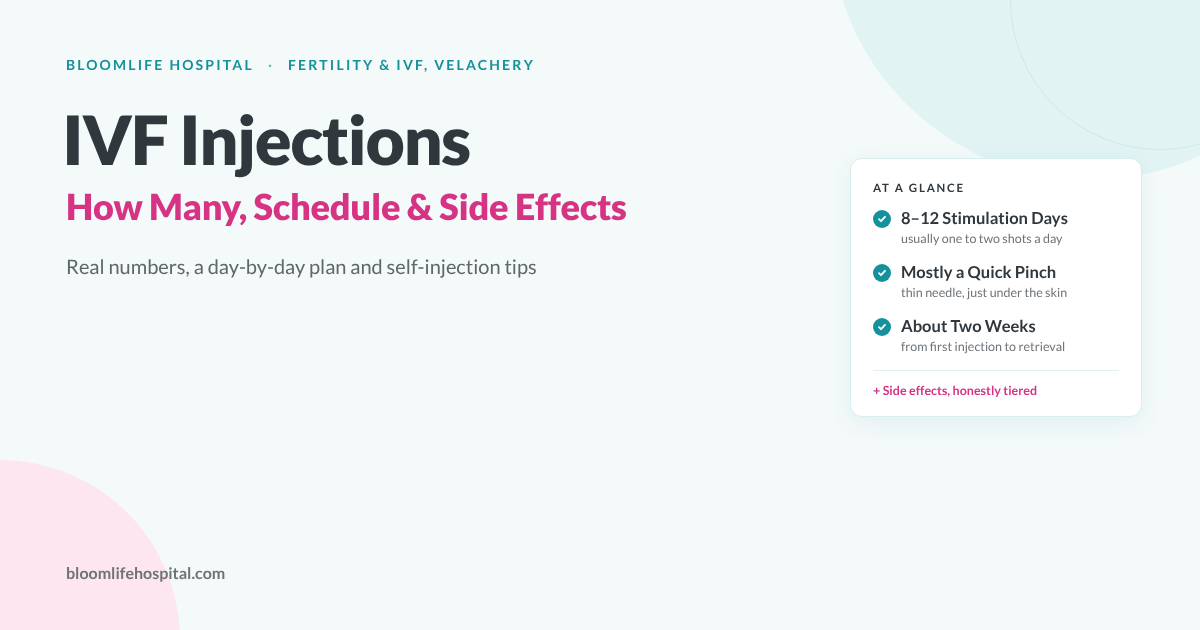
Most IVF cycles involve 80 to 150 injections in total—that sounds like a lot until you break it down. Stimulation injections run for 8 to 12 days, usually one to two shots daily, that’s roughly 8 to 24 injections right there. Add a single trigger shot at the end of stimulation, and progesterone support afterward, which can be daily injections or vaginal gel or tablets depending on your protocol, for another 10 to 14 days.
Protocol affects the exact count. An antagonist protocol, the most common one now, adds a few extra daily injections partway through stimulation specifically to prevent premature ovulation. A long agonist protocol starts injections earlier, sometimes a couple of weeks before stimulation even begins.
The Schedule, Day by Day
Here’s what a typical antagonist protocol cycle looks like. Individual protocols vary, so treat this as a general orientation, not your exact plan.
| Cycle Day | What’s Injected | Why |
| Day 2 or 3 | FSH injection begins | FSH tells your ovaries to grow multiple follicles instead of the usual one |
| Day 5 to 6 | FSH continues, monitoring scan begins | Tracking follicle growth and adjusting dose if needed |
| Day 7 to 8 | Antagonist injection added | Prevents your body from ovulating early, before retrieval is planned |
| Day 9 to 11 | FSH and antagonist continue, more frequent scans | Follicles approach the mature size, dose may be fine tuned |
| Trigger day | Single trigger injection | Final maturation signal, timed precisely, retrieval follows roughly 36 hours later |
| Retrieval day onward | Progesterone support begins | Supports the uterine lining for potential implantation |
FSH, follicle stimulating hormone, is the main workhorse—it directly tells your ovaries to grow more follicles than a natural cycle would. The antagonist is simply a brake, stopping your body from releasing eggs before the retrieval is scheduled. The trigger is the final go signal, timed to the hour rather than the day.
Do They Hurt? And How to Actually Self Inject
Most stimulation and trigger injections are subcutaneous, a thin needle just under the skin of your abdomen, genuinely less painful than most people expect, closer to a quick pinch than a typical blood draw. Progesterone, if given by injection rather than gel or tablet, is usually intramuscular, into the muscle, and this one does have a reputation for being more uncomfortable, some soreness at the site for a day or two is common.
A few things that actually help. Let the alcohol swab dry fully before injecting, as injecting into wet alcohol stings more than it needs to. Pinch a small fold of skin at your injection site rather than pressing flat. Rotate sites, left and right sides of your abdomen, rather than using the same spot daily, this reduces bruising and soreness building up in one place. Numbing the area briefly with an ice cube before injecting helps some women, though it’s optional, not essential.
Partners can absolutely give these injections, and many find it becomes a small shared ritual rather than a dreaded task once the first nervous attempt is behind you. Storage matters, most stimulation medications need refrigeration, check your specific drug’s instructions, and if you’re travelling, a small insulated cooler bag with an ice pack is usually sufficient for a few hours, not dry ice or a freezer.
Side Effects, Honestly Tiered
Common and mild. Bloating, mood swings, headaches, fatigue, and bruising or soreness at injection sites. These affect most women to some degree and are simply your body’s response to hormone levels well above a normal cycle.
Less common. Ovarian hyperstimulation syndrome, OHSS, is the one worth understanding properly rather than fearing vaguely. It happens in roughly 3 to 6 percent of IVF cycles, and means your ovaries have responded more strongly than expected to stimulation. Mild OHSS causes bloating and mild discomfort and usually resolves on its own. Warning signs that need a call to your clinic, rapid weight gain over a day or two, severe abdominal pain, vomiting, or difficulty breathing. Severe OHSS is uncommon, and your clinic monitors for early signs specifically to catch it before it becomes serious.
Rare. Allergic reactions to specific medications happen occasionally and are usually manageable by switching brands. Ovarian torsion, twisting of an enlarged ovary, is rare but is why sudden severe one sided pain always warrants an urgent call rather than waiting.
What these injections do not cause. A long standing fear worth addressing directly, there is no strong evidence linking fertility medications to an increased long term risk of ovarian or breast cancer. Large studies following IVF patients for years have not found this connection. It’s a reasonable question to ask, and the honest answer is reassuring.
The Emotional Side
Hormone driven mood swings during stimulation are real, not a personal failing or a sign you’re handling this badly. Feeling weepy, irritable, or simply not like yourself for a couple of weeks is common enough that it’s worth telling your partner in advance, so a hard day doesn’t turn into a fight about something else entirely.
If it feels heavier than ordinary stress, that’s worth naming to your clinical team rather than pushing through silently, counselling support exists specifically for this phase, and using it isn’t a sign you’re not coping well, it’s a sign you’re handling it sensibly.
How BloomLife Hospital’s Team Approaches This
At BloomLife Hospital, every patient starting stimulation gets a personalised schedule, not a generic pamphlet, along with a direct line to the nursing team for injection questions at any point during the two weeks. This phase genuinely does end, roughly two weeks from first injection to retrieval, and it’s the most physically demanding part of the whole process, not a preview of what the rest of treatment feels like.
If you’re staring at your own bag of injections right now, wondering if you can actually do this, that’s an entirely normal reaction, and our team is built to walk you through every single one.
Book a consultation or call 72999 11102, and ask about IVF cost including medications so there are no surprises on the billing side either.
For what comes after this phase, our guide on positive signs after embryo transfer ( do add the link once published ) covers the two week wait that follows.
Frequently Asked Questions
How many injections are needed for one IVF cycle?
Most cycles involve roughly 80 to 150 injections in total, one to two daily stimulation injections over 8 to 12 days, a single trigger shot, and daily progesterone support for another 10 to 14 days afterward. The exact count depends on your specific protocol and how your body responds to stimulation.
Are IVF injections painful? Most are subcutaneous and closer to a quick pinch than a typical blood draw, genuinely less painful than most people expect beforehand. Progesterone injections, if given intramuscularly rather than as a gel or tablet, tend to cause more soreness at the site for a day or two.
What are the side effects of IVF injections?
Bloating, mood swings, headaches, and injection site soreness are common and affect most women to some degree. Ovarian hyperstimulation syndrome affects roughly 3 to 6 percent of cycles and is usually mild, with your clinic monitoring closely to catch early warning signs before it becomes serious.
Can I take IVF injections myself at home?
Yes, most stimulation and trigger injections are designed for self administration or a partner to give at home, after a brief demonstration from your clinic’s nursing team. Site rotation and letting alcohol swabs dry fully before injecting both help reduce discomfort and bruising.
Do IVF injections cause weight gain?
Some bloating and temporary fluid retention are common during stimulation, which can feel like weight gain on the scale, but this typically resolves within a couple of weeks after the cycle ends. There is no strong evidence that fertility medications cause lasting weight gain beyond this temporary bloating.