
Medically Reviewed By
Dr. K. S. Kavitha Gautham
MBBS, MS (OG), DRM (Germany), FIMSA, FICOG · Senior Consultant & Managing Director, BloomLife Hospital
Dr. Kavitha Gautham is a fertility specialist and obstetrician-gynaecologist with over two decades of experience and more than 5,000 IVF cycles. She leads the Reproductive Medicine & Fertility Centre at BloomLife Hospital, Velachery.
View full profile →Your doctor said the egg will rupture about a day and a half after your trigger injection, and now every twinge in your lower abdomen feels like it might mean something.
It’s completely normal to feel this way.
Almost everyone going through an ovulation induction or IUI cycle Googles this exact phrase from a scan centre waiting room – phone in hand, trying to work out what ‘egg rupture’ actually means, what they’re supposed to feel, and whether it’s working.
Read on to know more about this process, starting from what egg rupture means, what you may or may not feel, and what it actually tells you about your chances of getting pregnant during this cycle.
What Does “Egg Rupture” Actually Mean?
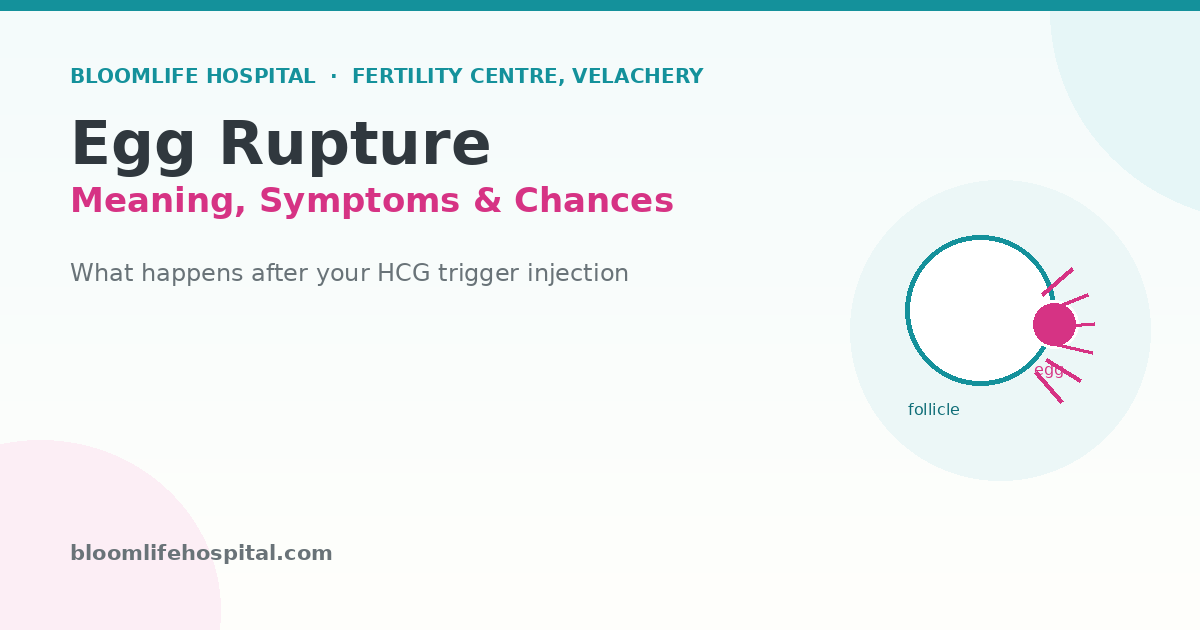
Egg rupture refers, in simplest terms, to the moment a mature follicle in your ovary breaks open and releases the egg inside it.
Now, this part tends to confuse most people, so it’s worth being precise.
The egg itself doesn’t rupture or break. The follicle, a small fluid-filled sac surrounding the egg, is the one that ruptures. The egg is simply released from it. Medically, this whole event is what we call ‘ovulation’.
In a natural, unmedicated cycle, your body triggers this release on its own, using a surge of a hormone called LH (Luteinizing Hormone). In a monitored cycle (ovulation induction or IUI), your doctor takes over that final step using an HCG (Human Chorionic Gonadotropin) injection instead, because it’s more predictable to time. HCG mimics the natural LH surge closely enough to trigger the same follicle rupture – on a schedule your doctor can plan around.
In this whole process, timing matters.
After the HCG trigger, rupture typically happens 36 to 40 hours later. Some cycles run slightly faster or slower, which is exactly why your doctor doesn’t just estimate it. The American Society for Reproductive Medicine’s patient guide to ovulation medication explains this same hCG-triggered process in more depth if you want the fuller clinical picture.
A follicular study (a series of ultrasounds) tracks the lead follicle’s size in the days before the trigger, generally to around 18 to 22mm, then confirms afterward whether it has actually collapsed and released the egg.
Symptoms You May, or May Not Feel
Here’s the part worth hearing clearly before anything else – many women feel absolutely nothing when the egg ruptures, and that is completely normal. Absence of symptoms is not a sign that something went wrong.
That said, some women do notice one or more of the following in the 24 to 48 hours around rupture:
- One-sided pelvic twinge or ache (Cleveland Clinic calls this mittelschmerz), usually mild, on whichever side the dominant follicle was on
- Light spotting, a few drops, nothing close to a period
- A change in discharge, often becoming clearer and more stretchy, similar to raw egg white
- Mild bloating, especially if you were on stimulation medication
None of these confirm rupture on their own, and none of them are required for rupture to have happened successfully.
What constitutes as a “need a call to your clinic”, rather than a wait-and-watch approach:
- Severe or one-sided pain that doesn’t ease up
- Fever
- Heavy bleeding, more than light spotting
The above-mentioned are usually uncommon, but they are worth flagging early rather than pushing through them at home.
A quick myth to retire: a lot of women assume that feeling a sharp twinge means the process worked, and that feeling nothing means it failed. Neither is true. Pain is just a side effect of some follicles rupturing close enough to the abdominal lining to be felt, and it has nothing to do with whether the egg inside was good quality or whether fertilisation is more or less likely. Plenty of successful cycles happen with zero sensation at all.
How Rupture Is Actually Confirmed
Since home symptoms can’t reliably confirm anything, this is where the follicular study earns its place. Your doctor will typically scan you once or twice before the trigger to measure the lead follicle, then again a day or two after, usually the same day as your IUI or timed intercourse window.
On that follow-up scan, your doctor is looking for two specific things:
- Whether the previously measured follicle has visibly collapsed (gone from a round, fluid-filled sac to a smaller, irregular shape)
- Whether there’s a small amount of free fluid near the ovary, which typically appears once the follicle has released its contents
Both together are what your doctor documents as a confirmed rupture.
Chances of Pregnancy After Egg Rupture
This is usually the real question underneath everything else: Rupture happened, so what are my actual chances this cycle?
Once the egg is released, it stays viable for fertilisation for about 12 to 24 hours. Sperm, on the other hand, can survive in the reproductive tract for up to 5 days, which is exactly why doctors don’t ask you to time intercourse or IUI to the exact rupture hour. Timed intercourse or IUI treatment in Chennai is generally scheduled 24 to 36 hours after the trigger, essentially just before or right around rupture, so sperm is already waiting when the egg arrives.
Per-cycle pregnancy chances vary meaningfully by age and by what’s actually causing the delay in conceiving. A cohort study following 1,437 IUI cycles found a per-cycle pregnancy rate of about 10.9% overall, rising close to 45% cumulatively after three cycles for couples with more favourable factors:
- Under 30, no other identified fertility issue: roughly 15 to 20% per cycle
- 30 to 35: roughly 10 to 15% per cycle
- Over 35: roughly 5 to 10% per cycle, sometimes lower depending on ovarian reserve
These numbers add up over multiple cycles rather than resting on any single attempt, which is part of why most doctors plan for 3 cycles of induction or IUI before reassessing, not just one.
‘Egg Ruptured, But I Didn’t Conceive.’ Why?
This is the question that brings a lot of women back to their doctor’s office.
Truth is, it’s rarely that simple. A confirmed rupture only tells you that one step in a long chain worked. Several other links in that chain matter just as much:
- Sperm quality: Count, motility, and shape all affect whether fertilisation actually happens even when a healthy egg is present and timing was right. The WHO’s laboratory manual for semen analysis is the standard reference doctors use to interpret these values.
- Tubal factors: If a fallopian tube is blocked or scarred, sperm and egg may simply never meet, regardless of how well the rupture itself went.
- Egg quality: A follicle can rupture and release an egg that isn’t chromosomally normal, more common with age, and this isn’t something a scan can detect.
- Luteal phase support: The two weeks after ovulation need enough progesterone to prepare the uterine lining for implantation. This is why most induction and IUI cycles include progesterone support afterward, not just the trigger itself.
- Timing accuracy: Even a few hours off from the intended window can matter, which is part of why clinics are strict about trigger and procedure timing.
If a cycle doesn’t result in pregnancy, your doctor will usually work through this list systematically rather than repeating the exact same cycle again, that’s the actual value of coming back for a review rather than trying on your own for another few months.
When to See a Fertility Specialist
As a general guide, it’s worth booking a proper fertility evaluation at our Chennai fertility centre if:
- You’ve been trying for 12 months without success (6 months if you’re over 35)
- You have PCOS or irregular cycles
- You’ve completed 3 or more ovulation induction cycles without a pregnancy
None of these mean something is seriously wrong – they’re simply the point where a more complete workup, rather than another round of the same approach, tends to be the better next step.
How BloomLife Hospital’s Fertility Team Approaches This
At BloomLife Hospital’s Reproductive Medicine & Fertility Centre, confirming egg rupture is never left to guesswork or a patient’s own symptom log. A follicular study tracks the lead follicle’s growth in the days before the trigger, then a follow-up scan after the HCG injection checks for a collapsed follicle and free fluid, exactly the two markers covered above, before any next step is planned.
If a cycle doesn’t result in pregnancy despite a confirmed rupture, the team works through the fuller picture rather than simply repeating the same protocol which is semen parameters, tubal patency, and luteal phase support are all reviewed alongside the fertility specialist. Since conditions like PCOS or unexplained cycle irregularities sometimes sit behind repeated unsuccessful cycles, this often includes input from BloomLife Hospital’s Obstetrics & Gynaecology department as well, not just the fertility team alone.
And if it’s been a while since a full evaluation, a Well Woman package as part of BloomLife Hospital’s Master Health Check-Up is a reasonable starting point before committing to another induction cycle, since it covers routine gynaecological and hormonal screening as part of a broader review.
Frequently Asked Questions
1. What does egg rupture mean after an HCG injection?
Egg rupture means the follicle containing your mature egg has broken open and released it, this is the medical process called ovulation. After a monitored cycle, your doctor uses an HCG injection to trigger this release at a predictable time, instead of waiting for your body’s natural hormone surge. The egg itself isn’t damaged in the process, only the surrounding follicle opens.
2. How many hours after the HCG injection does the egg rupture?
Rupture typically happens 36 to 40 hours after the HCG trigger, though it can range from about 24 to 48 hours depending on your individual response. This is why your doctor schedules your IUI or timed intercourse around this window, and why timing the injection precisely matters more than it might seem.
3. What are the symptoms of egg rupture?
Some women notice mild one-sided pelvic pain, light spotting, clearer stretchy discharge, or bloating. Others feel nothing at all. Symptoms depend on individual sensitivity and where the follicle sits, not on whether rupture actually happened. Severe pain, fever, or heavy bleeding are the exceptions that warrant a call to your doctor.
4. Can the egg rupture without any symptoms?
Yes, and this is extremely common. Many women have a confirmed rupture on ultrasound with zero physical sensation beforehand or after. Absence of symptoms doesn’t mean the trigger didn’t work, and presence of symptoms doesn’t guarantee it did. Ultrasound confirmation is the only reliable way to know.
5. What are the chances of pregnancy after egg rupture?
Per-cycle chances tend to vary by age and underlying cause, and are generally higher for women under 30 and lower for women over 35. Rupture confirms ovulation occurred, but pregnancy also depends on sperm quality, tubal health, egg quality, and timing, so it’s one necessary step, not a guarantee on its own.
6. Why did I not conceive even though the egg ruptured?
A confirmed rupture only means ovulation happened, it doesn’t rule out other factors like sperm quality, tubal blockages, egg quality, or insufficient luteal phase support. Most doctors review these systematically after an unsuccessful cycle rather than simply repeating the same protocol, since rupture was never the only variable involved.
Note: The information shared here is for educational purposes only – each individual’s / couple’s case history is unique, so medical guidance to their specific issues should be given only by the consulting doctor. If you have any queries, please contact your consulting doctor or call us at +91-94989 94989 to consult our experts.