
Medically Reviewed By
Dr. K. S. Kavitha Gautham
MBBS, MS (OG), DRM (Germany), FIMSA, FICOG · Senior Consultant & Managing Director, BloomLife Hospital
Dr. Kavitha Gautham is a fertility specialist and obstetrician-gynaecologist with over two decades of experience and more than 5,000 IVF cycles. She leads the Reproductive Medicine & Fertility Centre at BloomLife Hospital, Velachery.
View full profile →Felt a twinge? Could be implantation, could be nothing. Feeling nothing at all? That’s just as normal. Cramping, spotting, fatigue, that heightened sense of smell your friends keep mentioning…Do any of them actually mean something, or is this just progesterone doing what progesterone does?
While the embryo transfer itself takes minutes, the period after that process is the part nobody quite prepares you for. The next 10 to 14 days of analysing every twinge, every ache, every trip to the bathroom – all while wondering if it counts as a positive sign after embryo transfer or if you’re just imagining things. Here’s the honest, day-by-day version: What’s actually happening inside your body, which symptoms genuinely line up with a good outcome, and why the absence of any of them isn’t a bad sign either.
What’s Actually Happening After Your Transfer
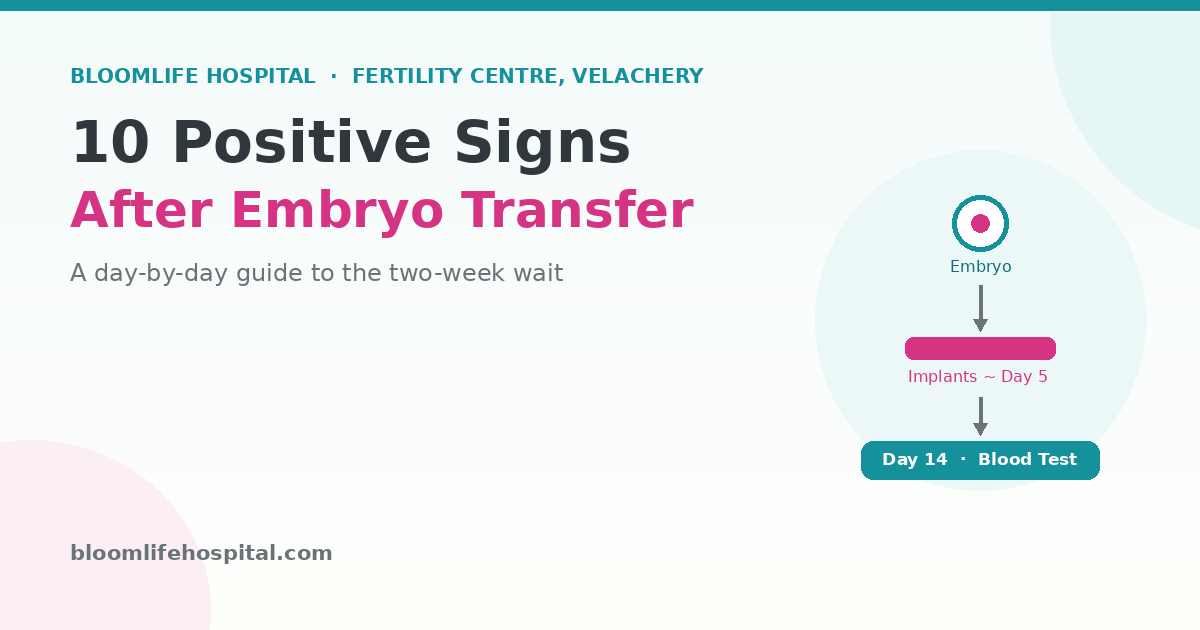
If you had a day-5 blastocyst transfer, which is the most common approach now, implantation typically begins within 1 to 3 days and is usually complete by day 5 or 6. If your transfer was a day-3 embryo, add roughly two extra days to this timeline, since the embryo needs that time to reach the blastocyst stage before it can implant.
Once implantation happens, your embryo starts producing hCG*, but only in tiny amounts at first, far too little for any test to pick up. Production of hCG ramps up gradually, becoming detectable in a blood test around day 8 to 9, and in a home urine test a few days after that.
*Note: Human chorionic gonadotropin or hCG is a hormone produced by the placenta shortly after implantation. It is produced by trophoblast cells that are surrounding a growing embryo (syncytiotrophoblast initially), which eventually forms the placenta after implantation.
10 Positive Signs After Embryo Transfer, Day by Day
1. Mild one-sided cramping (Days 3-5). Often described as similar to period cramps but milder, this lines up with the embryo attaching to your uterine lining.
2. Light spotting (Days 4-6). Sometimes called implantation bleeding, a few pink or brown-tinged drops, not a full flow. Not everyone gets this, and its absence means nothing on its own.
3. Mild bloating (Days 6-8). Your uterine lining is thickening and progesterone levels are climbing, both of which can leave you feeling puffier than usual.
4. Breast tenderness (Days 7-9). Rising hormone levels, from a possible pregnancy or from your progesterone support, or even both, commonly cause this.
5. Fatigue (Days 7-10). A genuinely common sign, though it overlaps heavily with simply being exhausted from the whole two-week wait in itself.
6. A basal body temperature that stays elevated (ongoing from transfer). If you’re tracking it, a sustained higher temperature rather than a dip can be encouraging, though it’s not something most patients need to monitor.
7. Increased urination (Days 9-12). As hCG rises and blood volume shifts, needing the bathroom more often is a common, if inconvenient, sign.
8. A heightened sense of smell (Days 9-12). An early pregnancy classic, tied to rising hormone levels, though plenty of successful pregnancies happen without it.
9. Mood swings (Days 8-12). Hormonal shifts affect mood regardless of the cause, so this one is particularly unreliable as a solo indicator.
10. A missed period and a positive blood test (Days 12-14). This is the only item on this list that actually confirms anything. Everything above it is a maybe. However, even this needs confirmation from your fertility specialist / obstetrician.
The Honest Warning Most Lists Skip
If you’re on progesterone support after your transfer (and most patients are on support), progesterone alone can cause every single symptom on this list. Cramping, breast tenderness, bloating, mood swings, even light spotting can all be medication side effects, completely independent of whether implantation happened.
Plenty of successful transfers produce zero noticeable symptoms across the entire two weeks, and plenty of unsuccessful ones produce a full checklist. Symptom-spotting isn’t a skill you’re failing at – it’s a genuinely unsolvable puzzle, since a successful and unsuccessful cycle can look identical from the inside.
When to Call Your Clinic Instead of Googling
Most sensations in the two-week wait are ordinary. A few aren’t, and deserve a call rather than a wait-and-see approach. These symptoms include:
- severe or persistent one-sided pain,
- heavy bleeding well beyond spotting,
- fever, or sudden severe bloating with difficulty breathing (a possible sign of ovarian hyperstimulation, more relevant if you had a fresh, stimulated cycle rather than a frozen transfer).
Confirming It, Not Guessing
Home tests can pick up hCG a few days before a clinic blood test in some cases, but a lingering trigger shot or unusually diluted urine can distort the result either way. Your clinic’s scheduled blood test, usually 12 to 14 days after transfer, is what actually confirms a pregnancy, since it tracks rising hCG levels over 48 hours rather than a single line on a strip.
A patient we saw last year had textbook implantation bleeding, and 48 hours later called us in tears, feeling certain it meant her cycle had failed. Her blood test two weeks later came back positive and she carried that pregnancy to term. What she’d actually experienced was ordinary implantation bleeding, exactly as described above, but no amount of reading about symptoms had prepared her for how ordinary things can still feel alarming in the moment.
How BloomLife Hospital’s Fertility Team Approaches This
At BloomLife Hospital, the two-week wait isn’t left entirely in your hands and a symptom checklist. Your fertility specialist schedules your blood test at the point it will actually give a reliable answer, not earlier, and reviews your specific protocol, including whether progesterone support could be shaping what you’re feeling, before drawing any conclusions from symptoms alone.
If you’re deep in your own two-week wait right now and want a straight answer instead of another forum thread, Book a consultation with BloomLife Hospital’s fertility team or call 72999 11102.
For the fuller picture of what led here, our guides on egg rupture and ovulation timing, and symptoms after IUI specifically cover the earlier stages this same two-week-wait anxiety shows up in. And if AMH or ovarian reserve is part of why you’re on this path, our piece on increasing AMH levels naturally is worth a read too.
Frequently Asked Questions
What are the positive signs after embryo transfer?
Mild cramping, light spotting, breast tenderness, fatigue, bloating and increased urination can all appear in the days following a successful transfer. None of them confirm a pregnancy on their own, since progesterone support causes identical symptoms regardless of outcome. Only a blood test 12 to 14 days after transfer gives a reliable answer.
Is cramping after embryo transfer a good sign?
It can be – mild cramping around days 3 to 5 is often linked to implantation. But it’s also a common side effect of progesterone support, which most patients take regardless of whether the cycle succeeds, so cramping alone can’t confirm the outcome either way.
Can embryo transfer be successful with no symptoms at all?
Yes, and this is common. Many successful pregnancies after embryo transfer produce no noticeable symptoms during the two-week wait. Absence of symptoms doesn’t indicate the transfer failed, symptoms and outcome simply aren’t reliably connected.
When should I take a pregnancy test after embryo transfer?
Wait for your clinic’s scheduled blood test, typically 12 to 14 days after transfer. Testing earlier risks an unreliable result, either a false negative because hCG hasn’t risen enough yet, or in rare cases a false positive from residual trigger medication.
How much does IVF cost in India in 2026?
IVF cost in India varies significantly by city and protocol, with ivf price 2026 ranges generally running higher in metros, and Chennai typically priced differently from ivf cost in Chennai vs Bangalore comparisons due to local overheads. The cost also depends on add-ons like ICSI, PGT, or donor gametes. A full, doctor-verified city-by-city breakdown is covered in our dedicated IVF treatment cost in India guide.