
Medically Reviewed By
Dr. K. S. Kavitha Gautham
MBBS, MS (OG), DRM (Germany), FIMSA, FICOG · Senior Consultant & Managing Director, BloomLife Hospital
Dr. Kavitha Gautham is a fertility specialist and obstetrician-gynaecologist with over two decades of experience and more than 5,000 IVF cycles. She leads the Reproductive Medicine & Fertility Centre at BloomLife Hospital, Velachery.
View full profile →Four days post-IUI, and you’ve already Googled ‘IUI success symptoms day by day’ more times than you’d like to admit, taken your temperature twice, and re-read the same forum thread at 1am looking for a cramp that matches yours. This is the two-week wait, and it turns almost every woman into a full-time symptom detective for two weeks straight.
Read further to know what’s actually happening inside your body day by day, which symptoms genuinely mean something, which mean absolutely nothing either way, and when testing will actually give you a real answer instead of a guess.
What Happens After IUI, Day by Day
Day 0, the procedure itself.
Processed sperm is placed directly into your uterus. This takes under five minutes and most women feel nothing more than a Pap-smear-level pinch. Nothing ‘happens’ yet in terms of pregnancy, this is just the starting point.
Days 1 to 3, the meeting window.
If timing lined up with your trigger shot, this is roughly when sperm and egg actually meet in the fallopian tube. You won’t feel this. There’s no sensation tied to fertilisation itself, whatever a symptom-spotting thread might suggest.
Days 4 to 7, travel and the earliest implantation signals.
A fertilised egg (now called a blastocyst) travels down toward the uterus and begins the earliest stages of preparing to implant. Most women feel nothing distinct here either, though this is often when the 2-week-wait anxiety properly kicks in, since there’s a real biological process underway that simply isn’t detectable yet.
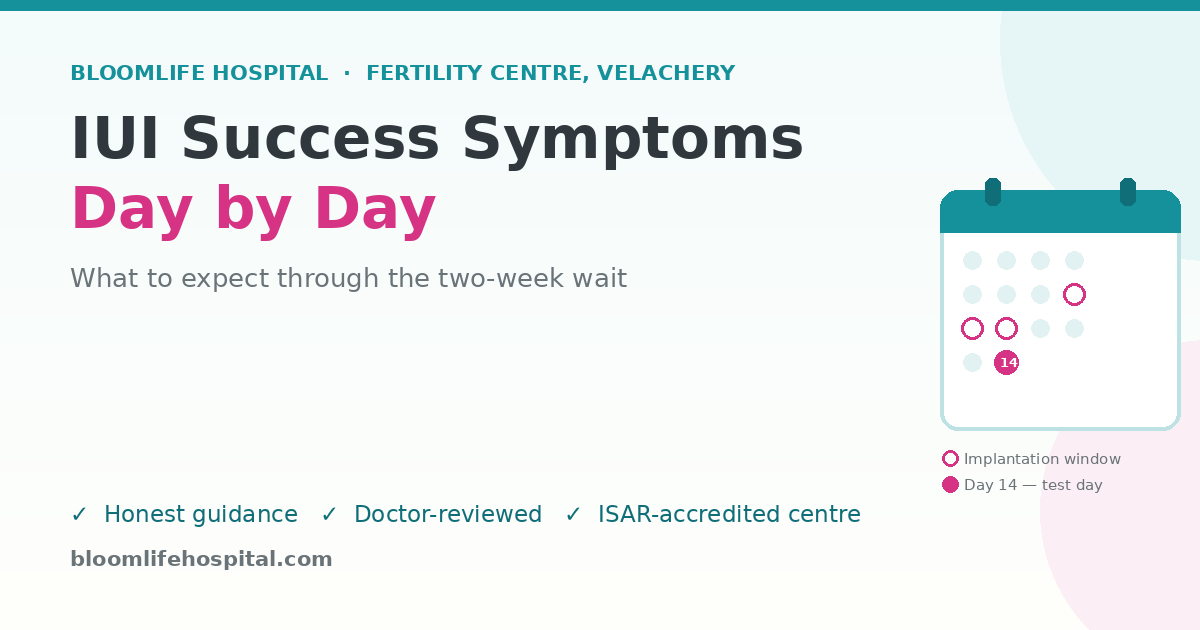
Days 8 to 10, the implantation window.
This is when implantation, the blastocyst attaching to your uterine lining, is most likely to occur if this cycle has worked. It’s also the window where most of the ‘symptoms that may mean something’ cluster around – covered in detail below.
Days 11 to 14, hormones rise if pregnant.
If implantation happens, hCG levels begin climbing, doubling roughly every 48 to 72 hours in a typical early pregnancy. This is also, not coincidentally, the exact window your clinic schedules your blood test for, since it’s the first point hCG is reliably high enough to detect with confidence.
Note: None of these stages come with a guaranteed feeling. Plenty of successful cycles produce zero noticeable symptoms across all fourteen days, and plenty of unsuccessful ones produce a full checklist of them.
Symptoms That May Indicate Success
Around days 8 to 12, some women notice one or more of the following, generally linked to implantation and the hormone shifts around it, our implantation symptoms explained guide ( link to the guide) covers this window in more depth if you want it:
- Light spotting, sometimes called implantation bleeding, a few pink or brown-tinged drops, nothing close to a period
- Mild cramping, usually milder and shorter than typical period cramps
- Breast tenderness, often more noticeable than usual
- Fatigue, feeling more tired than your usual baseline
Here’s the honest caveat that most symptom-spotting guides skip entirely – if you’re on progesterone support after your IUI, which most women are, progesterone alone can cause every single one of these symptoms.
Cramping, breast tenderness, fatigue, even light spotting can all be side effects of the medication itself, completely independent of whether implantation happened. There is genuinely no reliable way to look at this list and know which explanation applies to you.
Symptoms That Mean Nothing Either Way
This is probably the most useful section in this entire article, so take your time reading this slowly.
The absence of symptoms tells you nothing, and the presence of symptoms tells you nothing either. Both outcomes, pregnant and not pregnant, produce an almost identical set of physical sensations in the two-week wait, implantation bleeding itself is considered a normal, common part of early pregnancy, but its absence is just as normal.
This is because early pregnancy symptoms and PMS symptoms share the same underlying hormone, progesterone. Whether or not you’re pregnant, progesterone is elevated in your system during the luteal phase, either from your own corpus luteum or from your prescribed supplement. That’s why bloating, mood swings, mild cramping, and fatigue can show up in a cycle that fails just as easily as one that succeeds.
Symptom-spotting fails statistically exactly when you’re trying to distinguish between two states that produce the same evidence. It isn’t a failure of attention or intuition, it’s simply not a solvable puzzle from symptoms alone.
What Not to Do in the 2 Week-Wait
Don’t test early. If your cycle included an hCG trigger shot, and most IUI cycles do, that same hormone lingers in your system for up to 10 to 14 days after the injection. Testing before then can show a positive line that has nothing to do with pregnancy, it’s simply leftover trigger medication, not a real result. This is one of the more heartbreaking, and entirely avoidable, sources of false hope in the 2WW.
Skip the bed rest. This one surprises a lot of women. There’s no evidence that bed rest after IUI improves outcomes. Normal daily activity is generally considered fine. Strenuous new exercise or a sudden intense workout regimen isn’t recommended, but walking, your usual routine, and light activity don’t need to stop.
A quick word on household advice. If someone in your family has warned you off raw papaya during this window, that caution isn’t baseless. Unripe papaya contains a latex compound that’s traditionally associated with uterine contractions, so it’s a reasonable one tip to actually follow. Ripe papaya in moderation is generally considered fine. Most other common warnings (avoiding pickles, staying away from certain fruits, not stepping over things) don’t have a medical basis, but they usually come from genuine care, so there’s no need to argue the point at home, just quietly follow the ones that are grounded and let the rest go.
When and How to Test
The earliest a blood test can reliably detect a real pregnancy is around day 11, but 14 days post-IUI is the window most clinics, including ours, schedule for a blood beta-hCG test, since this gives the trigger shot enough time to fully clear and hCG enough time to rise to a confidently detectable level.
Blood tests are more sensitive than home urine tests and give you an actual number rather than just a line, which matters because your doctor can track whether that number is roughly doubling every 48 to 72 hours, a pattern more informative than a single yes-or-no result. If you do use a home urine test, a faint line at day 14 or later usually does mean a positive, though your clinic’s blood test remains the more reliable confirmation, and the one your treatment plan is actually built around.
If It’s Negative
If your test comes back negative, the number worth knowing is that per-cycle IUI success rates generally sit somewhere between 10 and 20%, meaning most successful outcomes happen across 3 to 4 cycles, not the first one. One negative cycle doesn’t say much about the next one, and it’s worth checking IUI cost in Chennai (link to the blog) if you’re budgeting for a few attempts rather than just one.
A patient we saw last year had three unsuccessful IUI cycles before hers worked, and by the third negative test she’d started to feel like something was fundamentally off. Nothing had changed medically between cycles two and three, her protocol simply needed that many attempts, which is a normal, expected part of how IUI works, not a sign of a deeper problem. If 3 or more cycles pass without success, that’s typically the point your doctor will suggest a fuller review of your IUI treatment in Chennai (link to the blog) and sometimes a conversation about moving to IVF, not because IUI failed you, but because the data at that point points toward a different tool being more likely to work.
How BloomLife Hospital’s Fertility Team Tests This
At BloomLife Hospital, you’re not left to sort this out with a home test and a forum thread. A blood beta-hCG test is scheduled for day 14 post-IUI, timed specifically so any trigger shot has fully cleared and true pregnancy hCG has had enough time to rise to a reliably detectable level, an approach consistent with FOGSI’s clinical practice standards for Indian fertility care. If that first result is positive, a second blood draw 48 hours later confirms the level is rising the way a healthy early pregnancy typically does, rather than relying on a single number in isolation.
This is also why the team generally discourages home testing before day 14, not to keep you waiting longer than necessary, but because an early result, positive or negative, is genuinely unreliable and tends to cause more distress than clarity. If your test comes back negative, your fertility specialist reviews the full cycle with you before deciding on next steps, rather than simply repeating the same protocol by default.
If you’re in the middle of your own two-week wait and want a straight answer instead of another forum thread, book a consultation with BloomLife Hospital’s fertility team or call 72999 11102.
Frequently Asked Questions
1. What are the symptoms of successful IUI day by day?
Days 1 to 7 typically feel like nothing, since fertilisation and early travel toward the uterus aren’t detectable. Days 8 to 12 are when some women notice light spotting, mild cramping, breast tenderness, or fatigue, linked to implantation. Days 11 to 14 bring rising hCG if the cycle worked, which is what your blood test is timed to detect.
2. Is cramping after IUI a good sign?
Not reliably, no. Mild cramping around days 8 to 12 can be linked to implantation, but it’s also a common side effect of progesterone support, which most women take regardless of whether the cycle succeeds. Cramping alone can’t tell you which explanation applies.
3. Can IUI be successful with no symptoms at all?
Yes, and this is extremely common. Many successful pregnancies after IUI produce no noticeable symptoms during the two-week wait at all. Absence of symptoms is not a sign the cycle failed, symptoms and outcome simply aren’t reliably connected.
4. When should I take a pregnancy test after IUI?
Wait until at least day 14 post-IUI for a reliable result. Testing earlier risks a false positive from a lingering hCG trigger shot, or a false negative because hCG hasn’t yet risen high enough to detect, even in a real pregnancy.
5. How many IUI cycles before success is likely?
Per-cycle success rates are generally in the 10 to 20% range, so most successful pregnancies happen across 3 to 4 cycles rather than the first attempt. If 3 or more cycles pass without success, your doctor will usually recommend a fuller evaluation to check whether a different approach, sometimes IVF, makes more sense going forward.