
Medically Reviewed By
Dr. K. S. Kavitha Gautham
MBBS, MS (OG), DRM (Germany), FIMSA, FICOG · Senior Consultant & Managing Director, BloomLife Hospital
Dr. Kavitha Gautham is a fertility specialist and obstetrician-gynaecologist with over two decades of experience and more than 5,000 IVF cycles. She leads the Reproductive Medicine & Fertility Centre at BloomLife Hospital, Velachery.
View full profile →A single number on a lab report – 0.8, maybe 1.2 – has probably taken over your entire week. You’ve read about supplements, seen the yoga claims, and maybe already ordered something online at 11pm. Through all the clutter of information you can find, here’s the honest version of how to increase AMH levels naturally – what genuinely works, what has a little evidence behind it, and what’s mostly marketing dressed up as science.
What AMH Actually Is
AMH (anti-Müllerian hormone) is a marker of egg quantity, (i.e.) roughly how many eggs remain in your ovarian reserve. It is important to understand that it doesn’t convey anything about your egg quality. A lower number doesn’t tell you anything about how healthy those remaining eggs are, and a high number doesn’t guarantee they’re all good ones either.
AMH is also not a reliable predictor of your natural conception odds, the way a lot of people assume. A landmark study published in JAMA followed 981 women aged 30 to 44 who had been trying to conceive for three months or less, and found that women with markers suggesting lower ovarian reserve, including low AMH, weren’t any less likely to conceive naturally within six or twelve cycles than women with normal levels. That’s a genuinely useful finding to hold onto, especially if you’ve been treating this one number as a verdict on your fertility.
AMH also naturally declines with age – that’s natural and to be expected, not a red flag on its own. And the number itself can vary somewhat between labs and even between cycles, so a single reading is a data point, not a diagnosis.
The Honest Truth About Raising AMH Levels
AMH largely reflects how many eggs you have left. Truth be told, you cannot re-grow your ovarian reserve. No supplement, diet, or yoga practice can create new eggs. If you’ve seen a website promise a specific percentage increase in AMH from a supplement blend, treat that number with real skepticism – it’s usually a small, uncontrolled study or a marketing claim, not settled science.
That said, small, real improvements are possible in some cases, particularly when a correctable issue, like a genuine vitamin D deficiency, thyroid imbalance, or high inflammation, was suppressing your number in the first place. Correcting that underlying issue can sometimes move your reading modestly.
But here’s the reframe that actually matters more than the number itself – the outcome you can meaningfully influence is egg quality, not egg quantity. That shift in focus, from “how do I raise my AMH” to “how do I support the eggs I have,” is the more useful question, and it’s the one the rest of this article is built around.
What Has Some Real Evidence Behind It
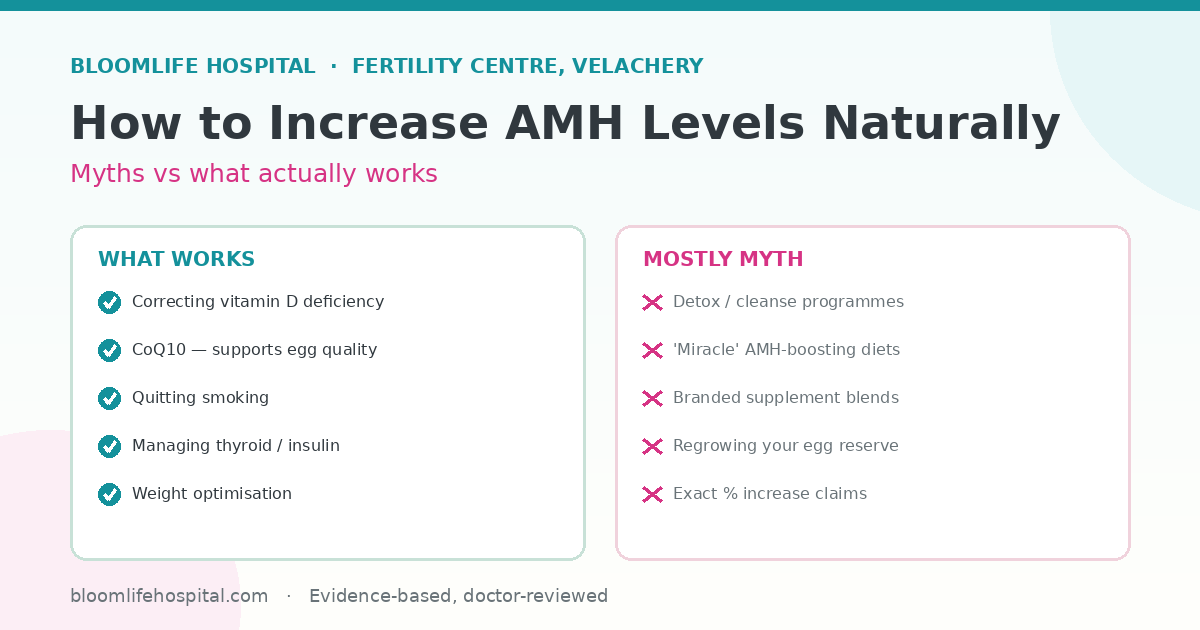
Vitamin D correction. The evidence here is genuinely mixed. A meta-analysis covering over 8,600 women found some regional and population differences in the vitamin D-ovarian reserve relationship, without a consistent, universal effect, while other individual studies have found no correlation at all between vitamin D levels and AMH.
What does this mean practically? If you’re genuinely deficient in Vitamin D (a simple blood test will confirm this), correcting it supports your overall health regardless of what it does to your AMH number specifically. Don’t supplement blindly without testing first.
CoQ10 (naturally occurring antioxidant found in every cell) for egg quality, not the AMH number itself. A randomized controlled trial of 186 women under 35 with diminished ovarian reserve found that 60 days of CoQ10 pretreatment before IVF led to better ovarian response and higher-quality embryos compared to no pretreatment. This is one of the better-designed studies in this space, and it’s specifically about egg quality and IVF outcomes, not about moving the AMH number itself. [Ask your doctor if this applies to you – don’t self-medicate.]
DHEA, but only under specialist supervision. Some studies have shown AMH improvements with DHEA supplementation, particularly in women under 38, but this is NOT an over-the-counter self-dosing situation. DHEA is a hormone, and taking it without proper testing and monitoring can cause real side effects, including acne and unwanted hair growth. If your doctor recommends it, it’s typically alongside regular blood work, not a supplement you pick up on your own. Follow your doctor’s instructions on dosage and timing to the tee.
Weight optimization, quitting smoking, and managing thyroid or insulin issues. These four are less flashy than a supplement stack, but they have the most consistent clinical backing. Both significant underweight and overweight can disrupt hormonal signalling relevant to fertility. Smoking is one of the more well-established accelerants of ovarian reserve decline. Undiagnosed thyroid dysfunction and insulin resistance both interfere with the hormonal environment your ovaries depend on, and both are things a straightforward blood panel can catch.
What is a Myth or is Overhyped
A lot of what circulates online promises far more than it can deliver. The usage of most comes from genuine hope, but because the hype itself can waste time and money at a stage when time often matters.
‘Miracle’ AMH-boosting diets. There’s no single food or eating pattern with solid evidence of meaningfully raising AMH. A generally balanced, anti-inflammatory diet supports overall health, which is worthwhile on its own, but it isn’t a targeted fix for ovarian reserve.
Most branded ‘fertility supplement’ blends. Many combine several ingredients (some with modest individual evidence, like CoQ10) into a proprietary mix and then advertise a specific percentage AMH increase from a small internal study. Be cautious of any number that sounds oddly precise, and check whether the study behind it was independently conducted or peer-reviewed.
Detoxes and cleanses. There’s no evidence that detox programs affect ovarian reserve or egg quality. Your liver and kidneys already handle this job without a special protocol.
None of this means lifestyle changes are pointless – it just means the honest goal is supporting your overall health and egg quality, not chasing a specific number on your next report.
What Actually Matters With Low AMH
Here’s where the real planning conversation happens. Your age and your AMH number together, not AMH alone, decide how much urgency makes sense. A 0.8 at 32 and a 0.8 at 40 lead to fairly different conversations with your doctor.
A few things worth knowing:
- Trying sooner rather than later tends to matter more than any single intervention, since time is the one factor you can’t fully offset.
- IUI has real limits with significantly diminished reserve, since it depends on a good egg being available and released in a given cycle.
- IVF and why low AMH changes the protocol, not the possibility. Low AMH generally means your doctor will use a different stimulation protocol, and you may produce fewer eggs per cycle, but it doesn’t rule out IVF working. It changes the approach, not whether pregnancy is achievable.
- Egg freezing, if you’re not ready to try yet, is worth discussing specifically because it locks in your current reserve rather than waiting through further natural decline.
If you’re trying to make sense of your own number rather than a general range, an AMH test and fertility testing in Chennai alongside a proper consultation is the only way to interpret it accurately for your specific situation, not a blog post, including this one.
How BloomLife Hospital’s Fertility Team Approaches This
At BloomLife Hospital, a low AMH result is treated as a planning signal, not a diagnosis delivered and left for you to sit alone. The first step is always ruling out correctable contributors, vitamin D deficiency, thyroid dysfunction, insulin resistance, before assuming the number reflects a fixed, unchangeable reserve. This is consistent with FOGSI’s clinical practice framework for fertility evaluation in India, which similarly emphasises a full diagnostic workup rather than treating a single biomarker in isolation.
From there, your fertility specialist maps out real options based on your specific age and number together, whether that’s trying naturally with closer monitoring, moving to IUI, or discussing IVF treatment in Chennai with a protocol suited to your ovarian response. If you’re not ready to pursue treatment yet, egg freezing is discussed as a genuine option, not an afterthought.
If a single lab number has taken over your week, that’s exactly the conversation worth having now, not after more Googling.Book a consultation with BloomLife Hospital’s fertility team or call 72999 11102, so the next thing you read about your AMH is a plan built around your actual number, not a general one.
A Planning Signal, Not a Verdict
Low AMH tells you something real about timing, but it doesn’t tell you your story is already decided. It changes which conversations to have sooner rather than later, not whether those conversations can lead somewhere good. The number on your report is a starting point for a plan, not the plan itself.
Frequently Asked Questions
1. Can AMH levels be increased naturally?
Not dramatically, and not by regrowing eggs – that isn’t possible. However, correcting an underlying issue like a genuine vitamin D deficiency, thyroid imbalance, or significant weight issue can sometimes modestly shift the number. The more reliable natural improvement is in egg quality, through weight optimisation, quitting smoking, and managing thyroid or insulin issues.
2. Which foods increase AMH levels?
No single food or diet has strong evidence of directly raising AMH. A generally balanced, anti-inflammatory diet supports overall reproductive health and egg quality, which is worthwhile, but it isn’t a targeted fix for the AMH number specifically. Be skeptical of any specific ‘AMH-boosting’ food list.
3. Does Vitamin D increase AMH?
The evidence is mixed. Some studies show a modest AMH improvement after correcting a genuine deficiency, while others find no correlation at all between vitamin D and AMH. It’s worth testing your levels and correcting a real deficiency for your overall health, without expecting it to reliably move your AMH number.
4. Can I get pregnant with low AMH?
Yes, if other factors work in the person’s favour. A major 2017 study found that women with markers of lower ovarian reserve, including low AMH, weren’t less likely to conceive naturally than women with normal levels. Low AMH does affect IVF protocol and expected egg yield, but it doesn’t rule out pregnancy, naturally or with treatment.
5. Does low AMH mean poor egg quality?
No, AMH measures egg quantity, not quality. A lower number means fewer remaining eggs, not that those eggs are unhealthy. Egg quality is influenced by different factors, including age, lifestyle, and specific nutrients like CoQ10, and is a separate consideration from your AMH reading.