You’re reading this alone, probably at night, probably after a report used the word you didn’t expect: ‘Azoospermia’, or zero sperm. It’s possible you’ve already decided fatherhood is off the table. Before you sit with that any longer, here’s the sentence that matters most in this entire article, said first, plainly, because you deserve to hear it before anything else:
Zero sperm in your semen does not mean zero sperm in your body.
For a substantial number of men with azoospermia, sperm is still being produced, it’s just not making it into the ejaculate, and modern retrieval techniques can often find it directly. Many men with this exact diagnosis have gone on to father biological children. This article is going to walk you through the real picture, honestly, including where the odds are genuinely harder, because you deserve information, not just reassurance.
What Azoospermia Actually Is
Azoospermia means no sperm detected in the ejaculate, but it’s not a diagnosis made from a single glance under a microscope. It’s confirmed only after a repeat semen analysis, with the sample spun in a centrifuge to concentrate any sperm that might be present in very low numbers, since a small number of sperm can be missed on standard examination alone.
It affects roughly 1% of all men, but a much larger share, 10 to 15%, of men specifically being evaluated for infertility find themselves facing this diagnosis. This means, if you’re reading this because a fertility work-up led here, you’re in a well-studied, well-understood category, and not a rare medical mystery.
Obstructive vs Non-Obstructive: the Crucial Fork
This distinction changes almost everything about your prognosis, so it’s worth understanding clearly before anything else.
Obstructive azoospermia means sperm production in the testicles is normal, the problem is a blockage somewhere in the transport pathway, the tubes that would normally carry sperm from testicle to ejaculate. Think of it as a healthy factory with a blocked delivery route. This category generally has a more straightforward path to retrieval, since the sperm exists in good supply, it just needs a different route out.
Non-obstructive azoospermia means the testicles themselves are producing very little or no sperm. This is a production problem, not a transport problem, and retrieval, while often still possible, is a more involved process with more variable outcomes.
How doctors tell the difference: Hormone levels are the first clue, FSH, a hormone that regulates sperm production, is usually normal or low in obstructive cases (since the testicle itself is working fine) and elevated in non-obstructive cases (since the body is producing more FSH trying, unsuccessfully, to stimulate a testicle that isn’t responding). A physical exam checking testicular size and firmness, and sometimes genetic testing, round out the picture.
Causes, by Category
Obstructive causes: A previous infection, including some sexually transmitted infections that went unnoticed at the time, is a common cause of scarring and blockage. A prior vasectomy is another straightforward, often reversible cause. Congenital absence of the vas deferens, the tube that carries sperm, is a less common cause, sometimes linked to being a carrier of the cystic fibrosis (CF) gene, which is why genetic counselling sometimes accompanies this specific diagnosis.
Non-obstructive causes. Hormonal imbalances affecting the signal from brain to testicle are one category. Genetic causes, including Y-chromosome microdeletions and Klinefelter syndrome, account for a meaningful share of cases and are identified through genetic testing. Varicocele, an enlargement of veins in the scrotum, is a common and sometimes treatable contributor. Past chemotherapy or radiation for cancer treatment can affect sperm production, sometimes temporarily, sometimes permanently, depending on the treatment. And worth repeating here, since it comes up regularly in our consultations, anabolic steroid use, including the kind used for bodybuilding or general gym performance, can shut down natural sperm production, sometimes for many months after stopping, this is one of the more common and most preventable causes we see in younger men.
Treatment Options: the Hope Section
This is where the honest headline from the opening becomes concrete. Here’s what’s actually possible, by category.
Correcting hormones: If a hormonal imbalance is driving non-obstructive azoospermia, targeted hormone therapy can sometimes restart or improve natural sperm production, occasionally enough to detect sperm in the ejaculate again without needing surgical retrieval at all.
Varicocele repair: If varicocele is a contributing factor, surgical repair can improve sperm parameters in some men, though the improvement, when it happens, unfolds over months, not immediately.
Surgical sperm retrieval: This is the core of modern azoospermia treatment, and it comes in a few forms depending on your specific diagnosis.
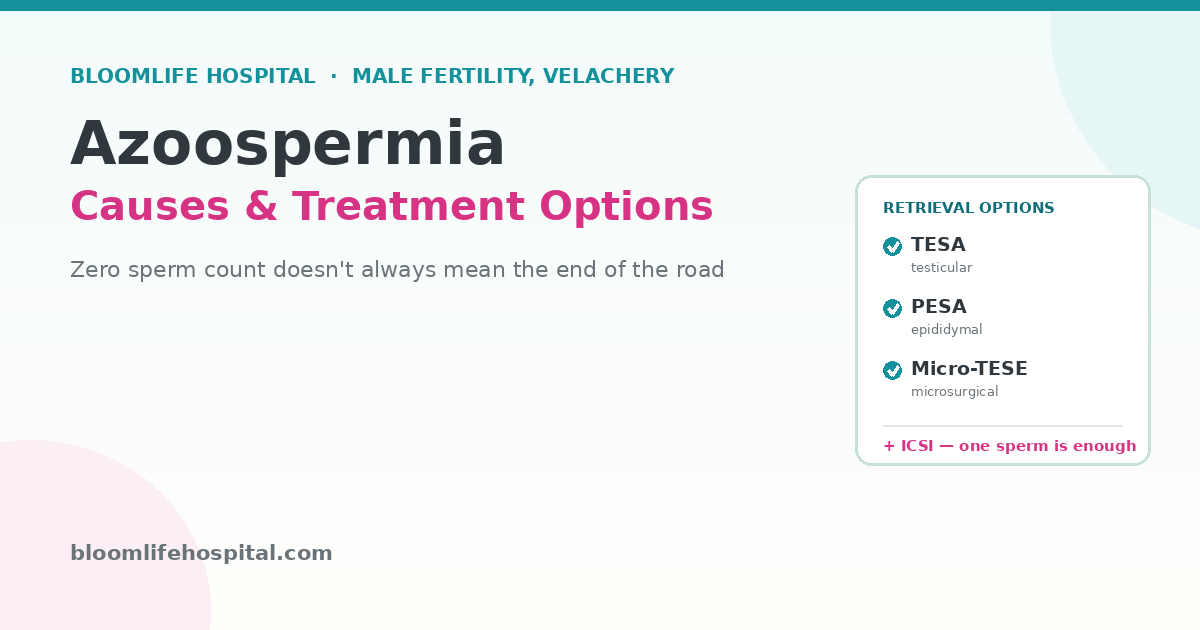
- TESA (testicular sperm aspiration). A needle is used to withdraw a small sample of testicular tissue, done under local anaesthesia, typically as a same-day outpatient procedure. Often the first approach is tried, particularly for obstructive cases.
- PESA (percutaneous epididymal sperm aspiration). Sperm is retrieved directly from the epididymis, the tube where sperm matures after leaving the testicle, using a fine needle. This is specifically suited to obstructive azoospermia, where sperm production is normal but blocked before reaching the ejaculate.
- Micro-TESE (microdissection testicular sperm extraction). A more involved surgical procedure using a microscope to identify and extract the specific areas of testicular tissue most likely to contain sperm. This is the technique of choice for non-obstructive azoospermia, where sperm production is patchy or minimal, and sperm retrieval rates with micro-TESE in these harder cases are commonly reported in the range of 25 to 50%, meaningfully better than older, less targeted retrieval methods.
ICSI with retrieved sperm. Whatever the retrieval method, even a small number of viable sperm is enough, since ICSI (intracytoplasmic sperm injection) involves injecting a single sperm directly into a single egg in the lab. You don’t need millions of sperm the way natural conception does, you need enough for the number of eggs retrieved from your partner, sometimes just a handful.
When is Donor Sperm Discussed?
If retrieval genuinely doesn’t succeed, even after an appropriate number of attempts, donor sperm becomes part of the conversation, respectfully, and only after retrieval options have been properly explored, not offered prematurely as a shortcut. This is a significant decision, and one that typically benefits from counselling support alongside the medical conversation, since it touches on identity and family building in ways that deserve space, not a rushed clinical recommendation.
Doctors at BloomLife Hospital have faced real-life cases involving azoospermia wherein the patient almost decided it was the end of the road – and then learnt otherwise. For instance, a patient came to the hospital last year, feeling certain his diagnosis meant the end of the road. His azoospermia turned out to be obstructive, from a childhood infection he barely remembered, and PESA retrieved more than enough sperm for ICSI.
This is an important learning: Please do not assume the outcome until the doctors have actually looked. Get the full workup and consult your doctor before you decide anything for yourself.
How BloomLife’s Team Approaches This
We perform TESA and PESA with ICSI on site, and every azoospermia case starts with the obstructive versus non-obstructive workup before any retrieval procedure is planned, since that distinction genuinely shapes the whole approach. Genetics counselling is available where the cause points toward a genetic factor, and we walk through retrieval odds honestly based on your specific hormone profile and exam findings, not a generic statistic.
To book a confidential andrology consultation, bring both your semen analysis and any hormone reports you already have. For background on what your original report showed, our guide on semen analysis explains how to read the numbers, and our piece on improving sperm health is relevant if hormonal or lifestyle factors are part of your picture.
Explore our male fertility clinic in Chennai or learn more about ICSI treatment in Chennai at BloomLife Hospital, or call 72999 11102.
Frequently Asked Questions
1. Can azoospermia be treated?
Yes, in many cases. Obstructive azoospermia often has a clear surgical retrieval path since sperm production itself is normal. Non-obstructive azoospermia is more variable, but retrieval and treatment through hormone correction, varicocele repair, or micro-TESE are all genuine options depending on the specific cause.
2. Can a man with zero sperm count have a baby?
Often yes. Zero sperm in the ejaculate doesn’t mean zero sperm production. Surgical retrieval methods, TESA, PESA, or micro-TESE depending on the cause, combined with ICSI, have helped many men with this exact diagnosis father biological children.
3. What is the difference between TESA and PESA?
TESA retrieves sperm directly from testicular tissue using a needle. PESA retrieves sperm from the epididymis, the tube where sperm matures after leaving the testicle. PESA is specifically suited to obstructive azoospermia, where the blockage sits between the testicle and the ejaculate.
4. What causes zero sperm count?
bstructive causes include prior infection, vasectomy, or congenital absence of the vas deferens. Non-obstructive causes include hormonal imbalance, genetic factors like Y-chromosome microdeletions or Klinefelter syndrome, varicocele, past chemotherapy, or anabolic steroid use.
5. Is azoospermia permanent?
Not always. Obstructive azoospermia can sometimes be surgically corrected or bypassed via retrieval. Non-obstructive azoospermia varies by cause, hormonal cases can sometimes improve with treatment, while genetic causes are typically permanent, though retrieval for ICSI may still be possible.