Your HSG is next week, and somewhere along the way you fell into a forum thread that made it sound like something to dread. “Agonizing” and “Worst pain of my life” — these are probably some terms that come up on the internet. You’re now seriously considering cancelling an appointment you scheduled specifically to move your fertility journey forward. Here’s the honest version, from doctors who do this procedure every week, not the worst-case stories that tend to dominate anonymous forums.
What HSG Checks, and Why It’s Usually First
HSG stands for hysterosalpingogram, an X-ray procedure that checks two things at once: One, whether your fallopian tubes are open (patent, in medical terms); and two, whether your uterine cavity has a normal shape. Both matter enormously for conception — a blocked tube prevents sperm and egg from meeting, and cavity abnormalities like a septum or polyp can prevent implantation even when fertilisation happens normally.
This is usually one of the very first structural tests in a fertility workup, alongside AMH and semen analysis, because it directly answers a foundational question, is there a physical blockage standing between you and pregnancy, before anyone discusses treatment options.
The Procedure, Minute by Minute
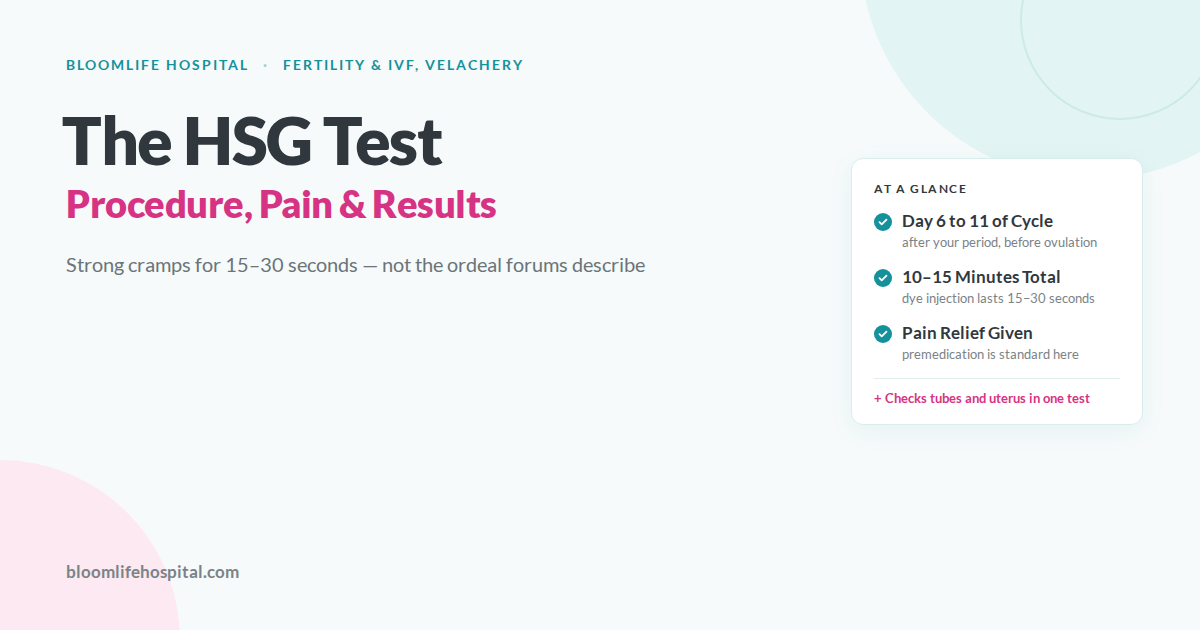
Timing. HSG is done between days 6 and 11 of your cycle, after your period ends but before ovulation, this timing avoids disrupting a potential early pregnancy and gives the clearest view of your uterine cavity.
Positioning. You’ll lie on an X-ray table in a position similar to a routine pelvic exam, feet in stirrups, a speculum used to visualise the cervix, the same setup as a Pap smear.
The dye. A thin catheter is passed through the cervix, and a contrast dye is slowly injected into the uterus. As it fills the cavity and flows into the fallopian tubes; if they’re open, the dye spills out the far end into the pelvis.
The X-ray. Live X-ray imaging (fluoroscopy) tracks the dye’s path in real time, your doctor watches the same screen you can usually see too, so you’re not left wondering what’s happening.
Total time. The entire procedure typically takes 10 to 15 minutes, with the dye injection itself, the part associated with any discomfort, lasting only 15 to 30 seconds.
The Pain Question, Answered Honestly
This is the section that actually matters most, so let’s not bury it in medical language.
Most women describe the discomfort as similar to strong menstrual cramps, sharp for a short window, then easing quickly once the dye injection is complete. It’s genuinely not comparable to labour, a root canal, or the “worst pain of my life” descriptions that circulate online; those accounts exist, but they represent a minority, not the typical experience.
Here’s the honest caveat: A minority of women, particularly those with a blocked tube, do experience more significant pain, since the dye has nowhere to go and pressure builds inside the tube before the procedure concludes. If this describes your experience, it doesn’t mean anything went wrong, it’s simply what a blockage can feel like during the test that’s designed to find it.
Premedication genuinely helps and is worth asking for. A pain reliever taken 30 minutes before the procedure, or in some cases a mild sedative, meaningfully reduces discomfort for most women, and there’s no downside to asking your clinic for this proactively rather than waiting to see how you feel on the day.
As Dr. Kavitha Gautham shares on this point: “Patients tell me they’ve read the test is unbearable and I understand why they’re scared walking in. What I see in the room, most of the time, is a wince, maybe a sharp breath, and then it’s over before they’ve really processed it. The anxiety beforehand is almost always worse than the fifteen seconds itself.”
Prep and Aftercare
Before the test, your clinic will confirm you’re not pregnant, generally via a urine test on the day, and may screen for active pelvic infection, since HSG is avoided if either is present. You’ll typically be advised to avoid intercourse for 24 hours beforehand to reduce infection risk.
Afterward, wearing a pad, light spotting or watery discharge for a day or two is completely normal as the dye and any residual fluid clear. Mild cramping can continue for a few hours, over-the-counter pain relief is usually sufficient. Call your clinic if you develop fever, heavy bleeding beyond spotting, or pain that’s worsening rather than easing, these are uncommon but worth acting on quickly if they occur.
Reading Your Results
Both tubes open. This is the most common and most reassuring result. It means natural conception or IUI remain reasonable paths forward, assuming other fertility factors check out.
One tube blocked. Pregnancy is still possible, since you only need one functioning tube each cycle, though your odds per cycle are somewhat reduced and your doctor may discuss whether IUI or IVF makes more sense depending on which tube and why it’s blocked.
Both tubes were blocked. This typically shifts the conversation toward IVF, since IVF bypasses the fallopian tubes entirely, fertilisation happens in the lab, not inside the tube, making tubal blockage largely irrelevant to that pathway’s success.
The curious effect is worth mentioning honestly, since it comes up often. Some women conceive naturally in the months following an HSG, more often than chance alone would explain. This isn’t folklore, tubal flushing with oil-based contrast specifically has been shown in large randomized trials to modestly raise pregnancy rates in the months afterward, likely from clearing minor debris or mucus from the tubes. The effect is real but modest, roughly a 10 percentage point increase in one major trial, not a guarantee, and not a reason to choose HSG as a treatment rather than a diagnostic test.
How BloomLife Hospital’s Team Approaches This
We offer premedication as standard practice for HSG, not something you have to specifically request, since we’d rather you walk in already informed that discomfort management is part of the plan. Our radiology team performs this procedure regularly, and we talk you through what you’re seeing on screen in real time rather than leaving you to interpret silence.
For the fuller fertility picture beyond tubal patency, our guide on AMH test explained covers the other core structural and hormonal tests typically done alongside HSG, and if results point toward a blocked tube, our page on IVF when tubes are blocked covers that pathway specifically.
To book your HSG or a complete fertility evaluation, explore fertility testing in Chennai at BloomLife Hospital or call +91-94989 94989.
Frequently Asked Questions
Is the HSG test painful?
For most women, it feels like strong menstrual cramps lasting seconds to a couple of minutes, concentrated around the moment dye is injected. A minority, particularly with a blocked tube, experience more significant discomfort. Premedication with a pain reliever beforehand genuinely helps.
What is the cost of an HSG test in Chennai?
Costs vary based on the type of contrast dye used and whether premedication is included. Ask for an itemised quote covering the full procedure rather than assuming one number covers everything.
When in the cycle is HSG done?
Typically between day 6 and 11 of your menstrual cycle, after your period ends but before ovulation. This timing avoids interfering with a potential early pregnancy and gives the clearest view of your uterine cavity.
What happens if HSG shows blocked tubes?
One blocked tube still allows natural conception via the open tube, though your doctor may discuss IUI or IVF depending on the cause. Both tubes blocked typically shifts the recommendation toward IVF, which bypasses the fallopian tubes entirely.
Can I get pregnant in the same cycle as an HSG?
Yes, and interestingly, pregnancy rates in the months following an HSG are modestly higher than average, an effect linked to tubal flushing with oil-based contrast in particular. It’s a genuine effect, though modest, not a guarantee.