
Medically Reviewed By
Dr. K. S. Kavitha Gautham
MBBS, MS (OG), DRM (Germany), FIMSA, FICOG · Senior Consultant & Managing Director, BloomLife Hospital
Dr. Kavitha Gautham is a fertility specialist and obstetrician-gynaecologist with over two decades of experience and more than 5,000 IVF cycles. She leads the Reproductive Medicine & Fertility Centre at BloomLife Hospital, Velachery.
View full profile →Somewhere between “is this normal” and “should I be worried,” most women end up googling about getting white discharge their period – at least once. It’s one of those topics nobody really talks about out loud, even though almost every woman experiences it.
To address the query briefly – white discharge before your period is usually completely normal. It’s your hormones doing exactly what they’re supposed to do. But “usually” isn’t “always,” and there are some signs worth paying attention to. Here’s how to tell the difference.
What Is White Discharge Before Period, Exactly?
The medical term for this is ‘leukorrhea’, a thin to slightly thick, milky white fluid produced by glands in the cervix and vaginal walls. According to the American College of Obstetricians and Gynecologists (ACOG), normal vaginal discharge is clear to white and doesn’t carry a noticeable odor.
The reason it tends to show up specifically before your period comes down to one hormone – progesterone. In the second half of your cycle (called the luteal phase, roughly the two weeks between ovulation and your period), progesterone becomes the dominant hormone in your body. This shifts your discharge from the clearer, stretchier texture you get around ovulation to something thicker, whiter, and creamier.
Mayo Clinic notes that discharge amount and texture naturally vary through the month, and that most women produce less than a teaspoon a day on average, though this varies quite a bit from person to person.
Types of Vaginal Discharge Throughout Your Cycle
Your discharge doesn’t stay the same all month. Understanding the different types of vaginal discharge at each stage makes it much easier to notice when something’s actually off, versus when it’s just your cycle doing its usual thing.
| Cycle Stage | Typical Discharge | What’s Happening Hormonally |
| Right after your period | Little to no discharge, sometimes dry | Estrogen and progesterone are both low |
| Approaching ovulation | Clear, stretchy, egg-white-like | Rising estrogen |
| Around ovulation | Increased volume, slippery, stretchy | Estrogen peak |
| After ovulation (luteal phase) | Thicker, white, creamy | Progesterone rises and dominates |
| Just before your period | Thick white discharge, sometimes slightly yellow-tinted | Progesterone remains elevated |
None of these stages should come with a strong odor, itching or irritation. If any of those show up alongside the discharge, that’s when it’s worth paying closer attention – more on that below.
Is Thick White Discharge Before Period REALLY Normal?
Yes, in most cases. As progesterone rises through your luteal phase, it’s completely typical for discharge to move from watery to noticeably thicker, sometimes described as lotion-like or creamy. This is simply your body’s normal premenstrual pattern, not a symptom on its own.
Where it stops being “just normal thick white discharge” and starts pointing toward something else is when you see changes in texture and accompanying symptoms, not thickness alone:
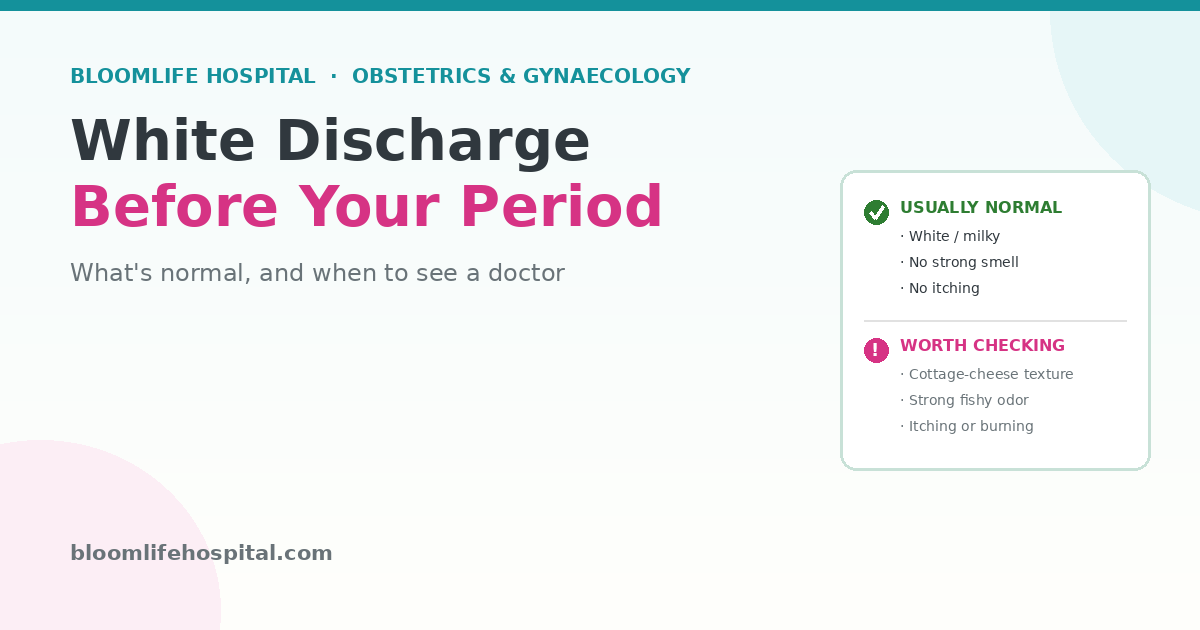
- Normal: thick, white or off-white, smooth or slightly clumped, no smell, no itching
- Worth checking: thick discharge that looks like cottage cheese, especially with itching or burning (commonly a yeast infection)
- Worth checking: thick discharge with a strong fishy odor, especially after your period or after sex (often bacterial vaginosis)
The Cleveland Clinic points out that discharge which is chunky, foamy, or paired with itching and color changes is more likely to signal an infection than one that’s simply thick and odorless.
Is White Discharge a Sign Your Period Is Coming?
It can be, though it’s not a reliable calendar. Many women do notice thicker white discharge as a discharge before period sign, simply because it lines up with the progesterone rise in the days leading up to menstruation. But it’s not a precise predictor, and it definitely isn’t a way to confirm or rule out pregnancy.
Here’s where most people get confused – early pregnancy discharge and normal premenstrual discharge look almost identical, both are driven by progesterone, both are white, thick, and mild-smelling. Appearance alone can’t tell you which one you’re dealing with. If you’re trying to figure out whether you’re pregnant, a pregnancy test is the only reliable way to know, not the discharge itself.
When Discharge Points to Something Else
Vaginal discharge changes for plenty of reasons beyond your regular cycle. A few common causes of abnormal discharge include:
- Yeast infection (candidiasis): thick, white, and clumpy, often compared to cottage cheese, usually with itching and burning.
- Bacterial vaginosis (BV): thin, greyish-white discharge with a distinct fishy odor, often more noticeable after sex or during your period.
- Trichomoniasis (an STI): yellowish-green, frothy discharge, sometimes with a fishy smell and irritation.
- Atrophic vaginitis: related to lower estrogen levels (common during breastfeeding or menopause), can cause dryness alongside abnormal discharge.
- Hormonal birth control or an IUD: can increase the overall amount of normal discharge without indicating a problem.
ACOG’s guidance on vaginitis is a good place to start if you want to understand these causes in more depth.
What to Check When You Notice Discharge: A Step-by-Step Guide
If you’re trying to work out whether what you’re seeing is normal, run through these in order:
Step 1: Check the color
Clear, white, or milky is typically fine. Grey, green, yellow, or blood-tinged (outside your period) is worth a closer look.
Step 2: Check the texture
Thin, stretchy, or thick and smooth are all normal at different points in your cycle. A cottage-cheese texture or frothy, bubbly texture is not.
Step 3: Check the smell
A very mild scent is normal. A strong, fishy, or foul odor usually isn’t.
Step 4: Check for other symptoms
Itching, burning, swelling, pain during urination or sex, or bleeding between periods are all signs to take seriously, regardless of what the discharge itself looks like.
Step 5: Note the timing
Discharge that shows up consistently at the same point in your cycle, month after month, is more likely to be a normal pattern. A sudden change from your usual baseline is the detail worth mentioning to a doctor.
When to See a Doctor
Healthline’s guidance on discharge before your period lines up with what most gynaecologists recommend: book an appointment with Bloomlife Hospital if you notice any of the following alongside your discharge:
- A strong or fishy odor
- Itching, burning, or swelling around the vulva
- A texture resembling cottage cheese
- Green, grey, or yellow coloring
- Pelvic pain or pain during sex
- Bleeding between periods, after sex, or after menopause
- Discharge that started after a new sexual partner
None of these need to be alarming on their own, most causes are common and very treatable. But they’re the details a gynaecologist will actually ask you about, so it helps to have them ready before your appointment.
How BloomLife Hospital’s Gynaecology Team Approaches This
At BloomLife Hospital’s Obstetrics & Gynaecology department, evaluating discharge usually starts with exactly the questions above: color, texture, odor, timing, and any accompanying symptoms. Depending on what’s found, a simple discharge sample or pelvic exam is often enough to identify the cause and start treatment, most vaginal infections clear up quickly once correctly diagnosed.
If irregular discharge is showing up alongside irregular periods, it’s also worth having a broader hormonal workup, since conditions like PCOS can affect both. This is something BloomLife Hospital’s Reproductive Medicine team can evaluate alongside your gynaecologist. And if it’s simply been a while since your last full check-up, a Well Woman package as part of BloomLife Hospital’s Master Health Check-Up covers routine gynaecological screening as part of a broader review.
Frequently Asked Questions
Is white discharge before period normal?
Yes, in most cases. It’s called leukorrhea and happens as progesterone rises in the days before your period. It should be white or clear, mild-smelling, and not accompanied by itching or irritation.
What are the different types of vaginal discharge I should know about?
Discharge changes across your cycle: little to none right after your period, clear and stretchy near ovulation, and thicker, whiter discharge in the days leading up to your period. Any discharge that’s green, grey, yellow, frothy, or has a strong odor falls outside these normal types.
Is thick white discharge before period a bad sign?
Not usually. Thick, smooth, white discharge without odor or itching is a normal premenstrual pattern. Thick discharge resembling cottage cheese, or paired with itching or a strong smell, is more likely to indicate an infection.
Is discharge before period a reliable sign I’m about to get my period, or that I’m pregnant?
It can hint that your period is approaching, since it tracks with your natural hormone cycle, but it isn’t precise enough to rely on. It also can’t tell you whether you’re pregnant, since early pregnancy discharge looks nearly identical to normal premenstrual discharge. A pregnancy test is the only reliable way to check.
When should I see a gynaecologist about vaginal discharge?
If you notice a strong odor, itching or burning, a cottage-cheese or frothy texture, unusual coloring, pelvic pain, or bleeding between periods, it’s worth getting checked. Most causes are common infections that clear up quickly once treated.
Can birth control or an IUD change my discharge?
Yes. Hormonal contraceptives and IUDs commonly increase the overall amount of discharge. This is usually harmless on its own, unless it comes with the other symptoms listed above.
Talk to a Gynaecologist If Something Feels Off
Most of the time, white discharge before your period is just your hormones doing their job, nothing to worry about, and nothing that needs treatment. The details that matter are texture, smell, and whatever else is going on alongside it, not the discharge alone.
If anything about your discharge feels different from your usual pattern, BloomLife Hospital’s gynaecology team can help you figure out why. You can book an appointment or call +91-94989 94989 to get it checked.