
Medically Reviewed By
Dr. K. S. Kavitha Gautham
MBBS, MS (OG), DRM (Germany), FIMSA, FICOG · Senior Consultant & Managing Director, BloomLife Hospital
Dr. Kavitha Gautham is a fertility specialist and obstetrician-gynaecologist with over two decades of experience and more than 5,000 IVF cycles. She leads the Reproductive Medicine & Fertility Centre at BloomLife Hospital, Velachery.
View full profile →A number on a lab report isn’t supposed to feel like a verdict, but an AMH result between 0.3 and 1.0 often does. Maybe a previous clinic told you donor eggs were your only real option. Maybe you’ve spent the days since scrolling forums that swing between false hope and outright panic. Neither extreme is the full picture, and the actual picture has more nuance in it than a single number suggests.
Anti Mullerian Hormone of AMH measures quantity, (i.e) how many eggs you likely have left. It doesn’t measure quality, and quantity alone was never meant to be the whole story.
What Low AMH Does (and Doesn’t) Mean
There’s so much information on AMH so let’s declutter it honestly. A low AMH tells your doctor to expect fewer eggs retrieved in an IVF cycle. It does not, on its own, tell your doctor those eggs are lower quality. Egg quality is driven primarily by age, not by AMH. A woman of 30 with an AMH of 0.5 typically has meaningfully better egg quality than a woman of 42 with an AMH of 1.5, even though the older woman’s number looks reassuring on paper.
This distinction matters because it changes what ‘low AMH’ actually predicts. It predicts how many eggs a stimulation cycle might yield. It does not reliably predict whether those eggs, once retrieved, will fertilise, develop normally, or result in a healthy pregnancy, that part is still mostly an age story.
Natural conception may still happens with low AMH, since AMH doesn’t reflect the one egg your body releases each month the way, but we have to view the possibility of conception in the light of more factors.
Natural Pregnancy With Low AMH
If you’re under 35, a low AMH on its own isn’t an immediate reason for alarm about natural conception. Your monthly chance of pregnancy is still governed largely by your age and cycle regularity, not just by your total remaining egg count. The honest caveat is that if you also have irregular cycles or another fertility factor alongside low AMH, that combination matters more than either factor alone.
This is where the operative advice genuinely is ‘try now, not later’. Not because low AMH itself blocks natural conception, but because AMH tends to decline further with time, and age is the variable working against you regardless of what your current number says. If you’ve been trying for 6 to 12 months without success, that’s the point to bring your AMH result to a fertility specialist rather than continuing to wait.
IVF With Low AMH: What Actually Changes
This is where a low AMH result genuinely does change your protocol, and understanding how helps you ask better questions at your consultation.
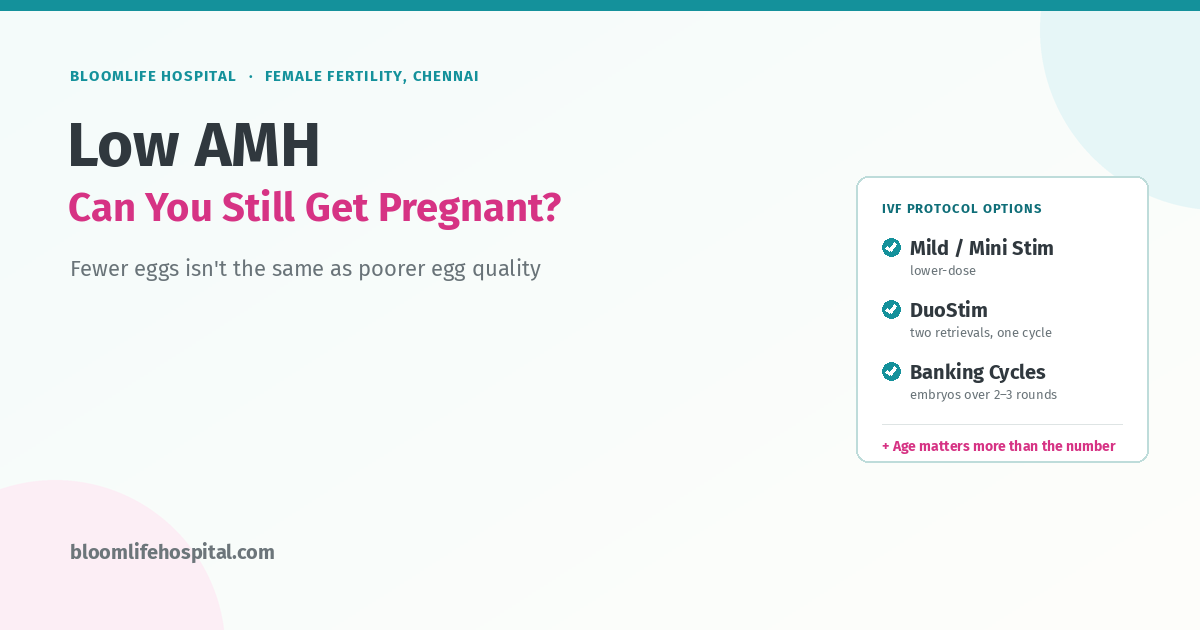
Stimulation approach. Standard high-dose stimulation protocols are built around retrieving many eggs from a normal reserve. With low AMH, some specialists use mild or mini stimulation instead, aiming for quality response over quantity, since aggressive dosing on a low reserve doesn’t reliably produce more eggs, it sometimes just produces more medication cost for the same yield.
DuoStim. One newer approach retrieves eggs twice in a single menstrual cycle, once in the follicular phase and once in the luteal phase, effectively compressing what would be two separate cycles into one, which matters when time and egg numbers are both limited.
Banking cycles. Rather than aiming for a single retrieval big enough to reach blastocyst and transfer, some low AMH patients do 2 or 3 retrieval cycles, freezing embryos each time, then transfer once enough embryos have accumulated. This spreads the numbers game across multiple attempts instead of betting everything on one cycle.
Realistic expectations, honestly. A low AMH cycle might yield 2 to 5 eggs rather than the 10 to 15 a normal reserve produces. This is the part worth understanding clearly: Per-transfer success rates and per-retrieval egg counts are different statistics, and clinics sometimes quote the more flattering one. Cumulative success across multiple cycles tends to be the more honest number for low AMH patients specifically, since it accounts for needing more attempts to reach the same embryo count a normal responder gets in one.
Research backs the core point here: Women with AMH between 0.2 and 1.0 ng/ml do achieve pregnancies through IVF, in meaningful numbers, though ovarian reserve research consistently shows outcomes vary widely within that range depending on age and how many cycles a patient pursues.
When Donor Eggs Enter the Conversation
Donor eggs are one option on a spectrum, not the automatic next step the moment your AMH comes back low. They typically enter the conversation after several own-egg cycles haven’t produced a viable pregnancy, particularly in women closer to or past 40 where age compounds the low reserve picture, or where repeated cycles show consistently poor egg or embryo quality rather than just low numbers.
This decision, when it comes, deserves to be made respectfully and on your own timeline, not rushed into by a single early conversation. A good fertility team presents it as a genuine option among others, with honest odds at each stage, rather than steering you there prematurely because it’s statistically the path most likely to succeed fastest.
Second Opinions Are Normal
Here’s a belief worth pushing back on, since it comes up in nearly every low AMH consultation we have. Being told ‘donor eggs are your only option’ by one clinic doesn’t make it universally true, protocols and philosophies genuinely differ between fertility centres, and a second opinion isn’t disloyalty to your first doctor, it’s due diligence on a decision this significant.
This is where Dr. Kavitha Gautham, Senior Consultant in Reproductive Medicine & Fertility, would reiterate the need for case-by-case verification. As she shares, “A 34-year-old patient came to us last year after being told her AMH of 0.5 meant own-egg IVF wasn’t worth attempting. We tried a banking approach over three cycles. She’s now expecting. I tell every patient the same thing, bring your reports, let’s actually look at your specific numbers together before ruling anything out.”
How BloomLife’s Team Approaches This
We see low reserve and repeat-failure cases regularly, and we start every consultation by reviewing your actual AMH result alongside your age, cycle history, and any previous treatment records, not by applying a blanket protocol based on the number alone. If you’d like a clearer picture of where your AMH values are at, or you’re earlier in the process and exploring improving AMH naturally, both are worth reading alongside this one.
To bring your AMH report and previous treatment records for a second opinion consultation, explore IVF for low AMH in Chennai or our broader fertility testing services, or call 72999 11102.
Frequently Asked Questions
1. Can I get pregnant naturally with low AMH?
Yes, particularly if you’re under 35 and otherwise cycling regularly. AMH reflects total egg reserve, not the single egg released each month, so natural conception remains possible. The operative advice is to try sooner rather than later, since age affects outcomes more than the AMH number itself.
2 What is the IVF success rate with low AMH?
Success rates depend heavily on age alongside AMH, and cumulative success across 2 to 3 cycles is usually a more meaningful number than any single cycle’s odds for low reserve patients.
3. Is AMH 0.5 too low for IVF?
No, an AMH of 0.5 ng/ml is low but not disqualifying. Published research shows pregnancies occur across this range, though egg yield per cycle is typically lower, which is why protocol choice and, sometimes, a multi-cycle banking approach matter more than the number alone.
4. Which IVF protocol is best for low AMH?
There’s no single best protocol, mild or mini stimulation, DuoStim, and banking cycles are all options your specialist weighs based on your specific reserve, age, and prior response to medication, if any.
5. Does low AMH mean early menopause?
Not necessarily, though very low AMH can sometimes signal an earlier transition toward menopause than average. It’s not a fixed prediction, and your doctor would typically look at AMH alongside other markers before suggesting a specific timeline.