
Medically Reviewed By
Dr. K. S. Kavitha Gautham
MBBS, MS (OG), DRM (Germany), FIMSA, FICOG · Senior Consultant & Managing Director, BloomLife Hospital
Dr. Kavitha Gautham is a fertility specialist and obstetrician-gynaecologist with over two decades of experience and more than 5,000 IVF cycles. She leads the Reproductive Medicine & Fertility Centre at BloomLife Hospital, Velachery.
View full profile →Somebody has already told you to lose weight and eat healthy, with zero specifics, and you have already tried googling a PCOS diet chart, only to land on quinoa and salmon plans that have nothing to do with the idli, rice and sambar your kitchen actually runs on. Here is a real one, built around South Indian staples, that you can genuinely start this coming Monday.
Why Food Actually Matters in PCOS
This part confuses most people, so it’s worth explaining simply. PCOS is closely tied to insulin resistance, meaning your body needs more insulin than usual to manage blood sugar. Higher insulin levels push your ovaries to produce more androgens, and that hormone shift is what drives many PCOS symptoms, irregular periods, acne, unwanted hair growth, and difficulty losing weight.
Food matters here because what you eat directly affects insulin levels. Meals that spike blood sugar quickly, white rice, refined flour, sugary drinks, ask your body for more insulin, which feeds the same cycle. Meals built around a lower glycaemic load ask for less.
Here is the number worth holding onto, a loss of just 5 to 10 percent of body weight can be enough to restore regular ovulation in many women with PCOS, according to research published in Human Reproduction. That is a genuinely achievable target, not an abstract goal – for a woman around 70 kilograms, that is roughly 3.5 to 7 kilograms of weight that needs to be reduced.
Principles Before the Plan
A few principles matter more than any single recipe.
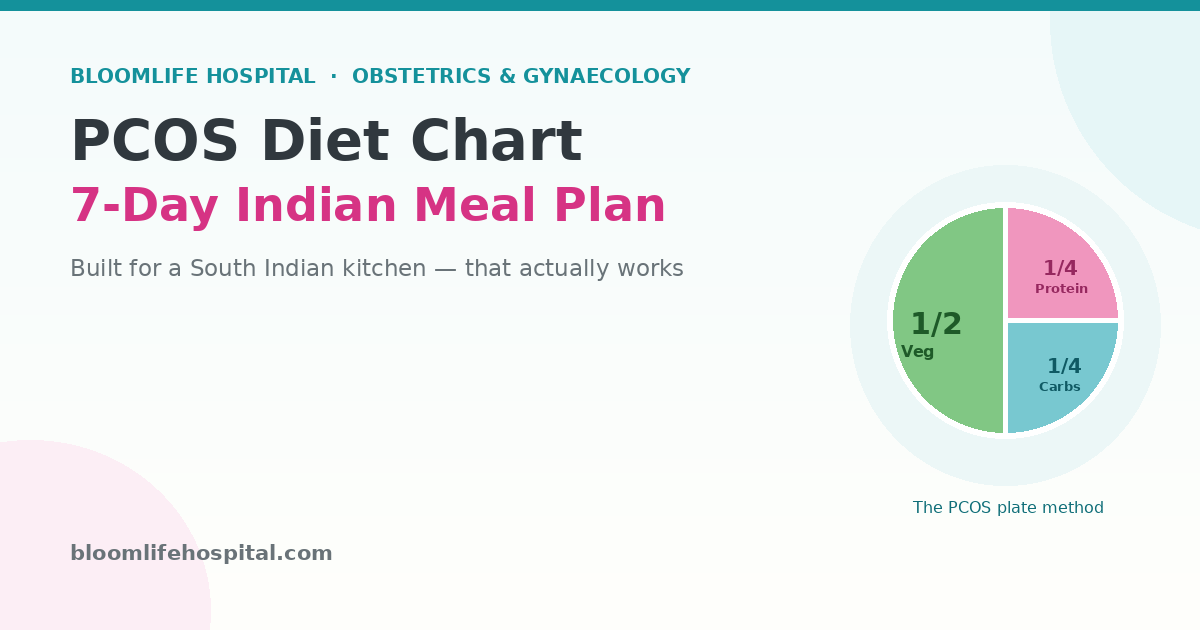
The plate method. Roughly halve your plate as vegetables, a quarter as protein, a quarter as complex carbohydrates. This alone shifts most traditional Indian meals in a useful direction without needing to abandon them.
Millets over polished rice, not zero rice. You do not need to eliminate rice entirely, that is neither necessary nor realistic for most South Indian households. Swapping some meals to ragi, jowar or kodo millet, and choosing brown or hand-pounded rice some of the time, lowers the overall glycaemic load of your week without asking you to give up your food culture.
Protein anchoring. Adding a protein source, eggs, curd, sprouts, dal or paneer to each meal slows down how quickly sugar enters your bloodstream, which matters more for PCOS management than most people realise.
Timing. Regular meal timing, not skipping breakfast, and not going long stretches without eating, helps keep insulin levels steadier through the day.
Cutting back on sugar and maida. This is the honest, less exciting part. Refined sugar and maida-based snacks are the biggest daily contributors to insulin spikes for most people – so reducing your intake of such foods is worth reducing even if you make no other changes per se.
What not to do: Crash diets and extreme keto style plans without medical supervision. Both can disrupt hormones further rather than help, and extreme approaches are rarely sustainable long enough to matter anyway.
The 7-Day Meal Plan
Individual needs vary based on your weight, activity level, and any other conditions, so treat this as a starting structure, not a rigid prescription.
| Day | Breakfast | Lunch | Snack | Dinner |
| Monday | Ragi dosa with sambar | Brown rice, sambar, beans poriyal, curd, 1 cup rice | Handful of roasted chana mixture | Millet upma with vegetables |
| Tuesday | Vegetable oats idli | Kodo millet rice, rasam, cabbage poriyal, 1 boiled egg | Sundal, 1 small bowl | Moong dal chilla |
| Wednesday | Moong dal idli | Brown rice, sambar, beetroot poriyal, curd | Buttermilk with roasted cumin | Vegetable stew with small appam |
| Thursday | Vegetable upma, eggs | Quinoa or millet pulao with vegetables, curd | Roasted makhana or peanuts | Ragi dosa with tomato chutney |
| Friday | Besan chilla | Brown rice, sambar, drumstick, 1 piece grilled fish or paneer | Sprouts salad | Millet khichdi with vegetables |
| Saturday | Idli, sambar | Jowar roti, dal, mixed vegetable curry, curd | Buttermilk | Vegetable curry with multigrain roti |
| Sunday | Pesarattu | Brown rice, rasam, avial, curd | Handful of nuts | Millet dosa with coconut chutney |
Foods to Limit, Without the Guilt
Nobody needs to demonise their own food culture to manage PCOS. A shorter, honest list matters more than a long scary one.
Limit sugary drinks and packaged juices, deep fried snacks, white bread and maida-heavy items, and excessive polished white rice. None of these need to disappear from your life entirely, just consumed more mindfully and responsibly.
Festival strategy, worth planning rather than avoiding: On days like Onam or Diwali, eat a normal balanced breakfast so you are not starving by the time the feast arrives, and enjoy the meal itself without guilt. One festival meal does not undo a week of steady habits, and treating it as a crisis usually backfires into all or nothing thinking.
Beyond Diet
Diet works best paired with movement – roughly 150 minutes of moderate activity a week, brisk walking counts, along with resistance exercise a few times a week if possible, since muscle itself improves insulin sensitivity. Sleep matters more than most people expect, as poor sleep worsens insulin resistance regardless of what you eat.
When diet and exercise alone are not enough – and this is genuinely common, not a personal failure – medication becomes part of the conversation, sometimes for insulin resistance directly, sometimes for ovulation induction if pregnancy is the goal. If lifestyle changes have not shifted your cycles after a few consistent months, that is the point to bring in a gynaecologist rather than trying harder alone.
How BloomLife Hospital’s Team Approaches This
At BloomLife Hospital, PCOS management always starts with a proper picture, weight, cycle history, and a hormone panel, before any diet recommendation is made, since a plan built on assumptions rarely fits the actual person in front of us.
If you have been managing PCOS with generic advice and no real plan, that consultation is worth having properly, not guessed at from another online chart. Book a consultation with BloomLife Hospital or call 72999 11102.
If your cycles have stayed irregular despite genuine effort, our piece on PCOD versus PCOS [NOTE: sibling post B13, placeholder pending its own publication] explains which term actually applies to your situation and why it matters. And if fertility is part of your concern alongside your cycles, our guide on the ten things that affect fertility is worth reading alongside this one.
Frequently Asked Questions
1. What is the best diet chart for PCOS?
There is no single universal chart, but the best approach follows the plate method, half vegetables, a quarter protein, a quarter complex carbohydrate, with millets swapped in for some rice meals and regular meal timing. A South Indian kitchen can absolutely follow this without switching to Western style foods.
2. Can I eat rice if I have PCOS?
Yes, rice does not need to be eliminated. Swapping some meals to brown rice, hand pounded rice, or millets, rather than removing rice entirely, lowers your week’s overall glycaemic load while keeping your meals realistic and sustainable.
3. Which Indian breakfast is good for PCOS?
Protein forward options work well, moong dal idli, besan chilla, vegetable oats idli, or pesarattu. Pairing any breakfast with a protein source, egg, curd, or dal, slows down the blood sugar spike compared to a plain carbohydrate only breakfast like white idli with sugar heavy chutney.
4. How much weight loss helps PCOS?
Research suggests just 5 to 10 percent of body weight can be enough to restore regular ovulation in many women with PCOS. For a woman around 70 kilograms, that is roughly 3.5 to 7 kilograms, a genuinely achievable, non extreme target rather than a dramatic transformation.
5. Which foods should be avoided in PCOS?
Sugary drinks, packaged juices, daily deep fried snacks, and maida heavy items are the main ones worth limiting. None need to be eliminated entirely or treated as forbidden, moderation and consistency matter far more than a rigid banned foods list.