
Medically Reviewed By
Dr. K. S. Kavitha Gautham
MBBS, MS (OG), DRM (Germany), FIMSA, FICOG · Senior Consultant & Managing Director, BloomLife Hospital
Dr. Kavitha Gautham is a fertility specialist and obstetrician-gynaecologist with over two decades of experience and more than 5,000 IVF cycles. She leads the Reproductive Medicine & Fertility Centre at BloomLife Hospital, Velachery.
View full profile →Two weeks ago, the beta came back negative, and since then you’ve probably felt some combination of grief, anger…and a quiet, exhausting kind of research spiral. Trying again, switching ivf clinics in Chennai , or stopping altogether? The questions swirl around insistently. Before anything else is spoken about, honestly accept that the grief is real and it deserves to be sat with, not rushed past with statistics. When you’re ready for them, this blog can help you understand why this happened.
The Honest Base Rates
This part matters more than almost anything else in this article. Failure is statistically common, even at excellent clinics, even with everything done correctly. Per cycle live birth rates run roughly 40 to 50 percent under age 35, around 40 percent at 35 to 37, closer to 25 percent at 38 to 40, about 15 percent at 41 to 42, and below 5 percent after 42 (when using a patient’s own eggs).
IF You are Looking for Fertility Centre in Chennai
Read those numbers again, slowly.
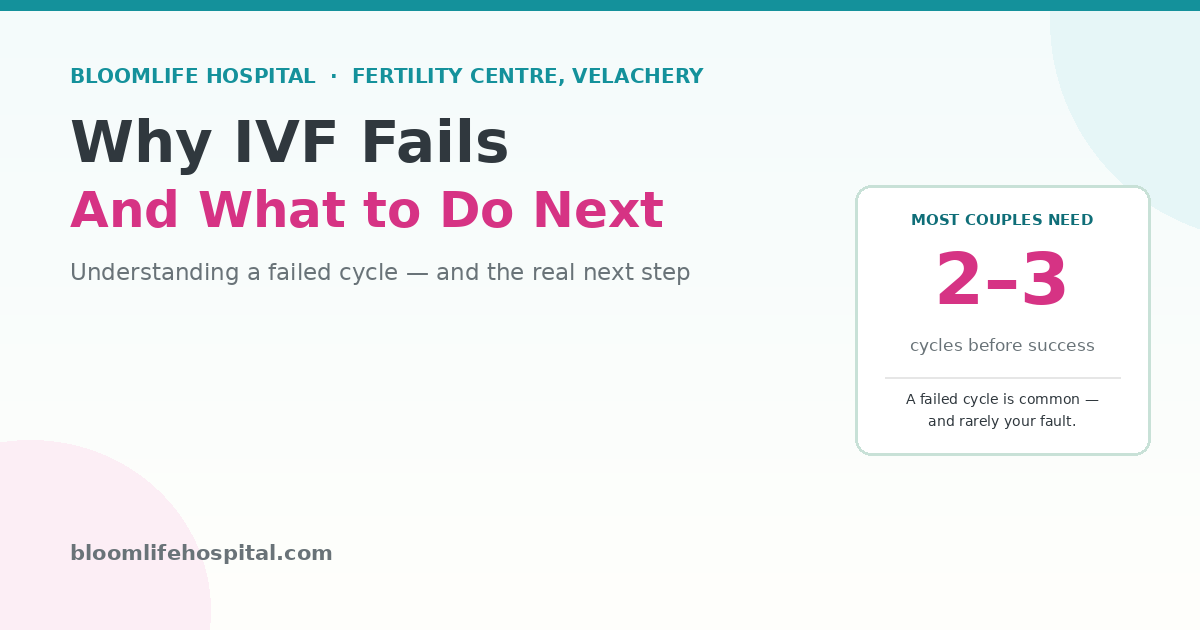
Even in the best case, under 35, a single cycle fails more often than it succeeds. This isn’t a reason to lose hope – it’s the reason self blame doesn’t actually fit the situation. Most couples need 2 to 3 cycles before success, not because anything went wrong the first time, but because that’s simply how the odds work at every single clinic, everywhere.
Why IVF Fails, the Real Reasons
Embryo chromosomal issues: The proportion of embryos with the wrong number of chromosomes rises sharply with age, from roughly 25 to 30 percent under 30 to well over half past 40. Most chromosomally abnormal embryos simply don’t implant, or end in early miscarriage, regardless of how good the lab or the transfer technique was. PGT-A, preimplantation genetic testing, can screen embryos for this before transfer, though it comes with its own cost and considerations worth discussing directly rather than assuming it’s always the right next step.
Implantation and endometrial factors: Even a chromosomally normal embryo needs a receptive uterine lining at the right moment. Endometrial receptivity analysis, can check whether your lining’s implantation window lines up with when your embryo was transferred, useful specifically for women with repeated unexplained failures, though the evidence for how much it improves outcomes is still evolving.
Egg or sperm quality: Beyond chromosomal count, overall egg and sperm health affects embryo development in ways a standard scan can’t fully capture. Detailed semen analysis beyond a basic count, and sometimes a review of ovarian response patterns from the stimulation itself can help see if these are some issues to be looked into.
Lab factors: Incubator conditions, air quality, and embryologist technique all genuinely affect embryo development, this is one reason outcomes vary between clinics even with similar patient profiles. This is more about clinic choice upfront, so be sure to do your homework well.
Protocol fit: Not every stimulation protocol suits every patient equally, a protocol well suited to one woman’s hormone profile might not be the best fit for another. Reviewing your actual stimulation response, follicle growth pattern, and hormone levels from the failed cycle to see whether a different protocol might suit you better.
Unexplained Factors: Sometimes, honestly, no clear reason emerges even after a thorough review. This is genuinely one of the harder outcomes to sit with, since there’s no clean explanation to hold onto, but it doesn’t mean nothing can be adjusted, sometimes a different approach still works even without a fully identified cause.
The Review Consultation
A proper failed cycle review isn’t a quick five-minute chat, it’s a genuine analysis of your specific cycle data, follicle growth pattern, hormone levels at each stage, embryo development and grading, and the transfer itself, looking for anything that might change next time.
This is the kind of review BloomLife Hospital specifically specialises in, we’ve worked through failed cycle reviews for patients who came to us after unsuccessful attempts elsewhere, and the review itself often surfaces a specific, actionable change, a protocol adjustment, a previously unconsidered test, rather than simply repeating the same approach and hoping for a different result.
Deciding What’s Next
There’s no single right answer here, and every option below is valid depending on your specific situation. Trying again with adjustments based on the review findings. Switching to a different protocol entirely if the data points that way. Exploring donor eggs or sperm, if egg or sperm quality has emerged as a significant factor. Pausing treatment for a while, financially, emotionally, or both, which is a legitimate choice, not giving up.
The financial reality deserves honest acknowledgement too, another cycle is a real cost, and it’s entirely reasonable to factor that into your decision alongside the medical picture. And if you’re considering a second opinion, whether from us or elsewhere, that’s a normal, sensible step, not a betrayal of your current clinic, a meaningful number of patients who come to BloomLife Hospital specifically are seeking exactly that, a second, careful look after a difficult first attempt.
Coping
Grief after a failed cycle is real grief, not an overreaction, and it doesn’t move through a tidy five-stage process on a schedule. Relationship strain during this time is common too, two people processing the same loss differently, at different speeds, is not a sign anything is wrong between you, it’s simply how grief often works.
Counselling support exists specifically for this, and using it isn’t a sign you’re not coping, it’s a sign you’re handling something genuinely hard with the seriousness it deserves. Support communities, other couples who’ve been through failed cycles, can also help in a way that’s different from anything a doctor can offer, sometimes what helps most is simply not feeling alone in it.
Talk to BloomLife’s Team
If you’re ready for a proper review, bring whatever records you have from your previous cycle, stimulation details, embryo reports, anything your previous clinic can provide, so the conversation starts from your actual data rather than a general conversation. Book a cycle review consultation at BloomLife Hospital or call 72999 11102.
For what a successful cycle’s early days can look like when you’re ready to try again, our guide on embryo transfer outcomes is worth reading when the time feels right, no rush.
Frequently Asked Questions
1. Why does IVF fail even with good embryos?
Even genetically normal embryos can fail to implant due to endometrial receptivity timing, subtle uterine factors, or simply the inherent unpredictability of implantation itself. A good embryo significantly improves the odds, but doesn’t guarantee success, which is part of why per cycle success rates remain well under 100 percent even in ideal cases.
2. What should we do after a failed IVF cycle?
A proper review of your specific cycle data, follicle response, hormone levels, embryo development, and the transfer itself, is the most useful first step, ideally before deciding whether to try again, switch protocols, or consider other options. This review often reveals a specific, actionable adjustment rather than leaving you to guess.
3. How long should we wait after a failed IVF to try again?
This varies by individual circumstances, physically, most women can start another cycle within one to two menstrual cycles if there are no medical reasons to wait longer. Emotionally, there’s no fixed timeline, and taking longer to feel ready is entirely reasonable and doesn’t affect your chances later.
4. Does a failed IVF mean the next will also fail?
No. Most couples who eventually succeed, need 2 to 3 cycles to get there, and a failed cycle doesn’t predict the outcome of the next one, especially if the review process identifies an adjustment worth making. Many successful pregnancies follow one or more earlier failed attempts.
5. What tests are done after repeated IVF failure?
Common tests include an ERA test to check endometrial receptivity timing, PGT-A to screen embryos for chromosomal issues, a hysteroscopy to examine the uterine cavity directly, and sometimes an immune workup, though evidence for immune testing specifically is more limited and worth discussing directly with your doctor.