Light spotting, five days before your period is due, and now you’re oscillating between two feelings that don’t fit together, hope that this might be implantation, and the more cautious voice telling you it’s probably just an early period.
Here’s a precise answer on implantation symptoms, exactly how bleeding differs from a period, and the honest timeline behind it.
What Implantation Is, and When It Happens
Implantation is the moment a fertilised egg, by this point a blastocyst, attaches to your uterine lining. It typically happens 6 to 12 days after ovulation, most commonly around day 8 to 10.
The full timeline looks like this:
Ovulation releases the egg → Fertilisation happens within about 24 hours if sperm is present → The fertilised egg travels toward the uterus over the next several days → Implantation occurs once it reaches and attaches to the lining → Only after implantation does your body begin producing hCG, the hormone pregnancy tests actually detect.
This is why testing too early, before implantation has even happened, gives you nothing to detect yet. It’s not that the test failed; there’s simply no hCG present.
Implantation Bleeding vs Period, the Comparison
This is the part worth studying closely, since it’s the actual question underneath everything else.
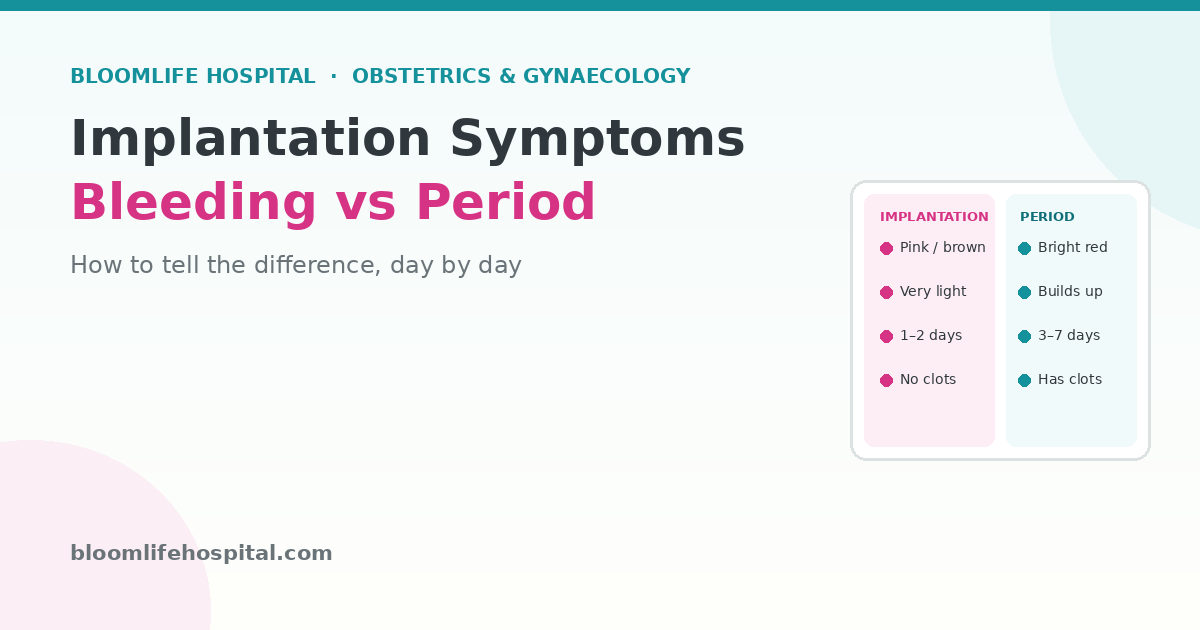
| Implantation Bleeding | Period | |
|---|---|---|
| Timing | 6–12 days after ovulation, before your period is due | Starts on your expected period date |
| Colour | Pink or light brown | Bright to dark red |
| Flow | Very light, spotting only | Starts light, builds to a normal flow |
| Duration | Usually 1–2 days, rarely 3 | Typically 3–7 days |
| Clots | None | Common, especially on heavier days |
| Cramps | Mild, brief — often a light pulling sensation | Mild to significant, often building over the first day or two |
Other ‘Claimed’ Implantation Symptoms, Honestly Rated
A lot of lists online claim a wide range of symptoms as implantation signs. Here’s a more honest breakdown of what’s actually meaningful versus what’s just as likely to be nothing.
Cramps: Genuinely reported by some women around the implantation window, mild and brief. Rating, plausible, but not reliable on its own, since ordinary premenstrual cramping feels similar.
Temperature dip: Some women tracking basal body temperature notice a brief single day dip around implantation, followed by a sustained rise. Rating, one of the more genuinely documented signs, but only useful if you’re already tracking daily, not something to check for retroactively.
Breast changes: Tenderness or sensitivity is commonly reported. Rating, unreliable alone, since progesterone causes the exact same sensation whether or not implantation has occurred.
Nausea timing: True pregnancy nausea generally doesn’t start until a couple of weeks after implantation, once hCG has risen substantially. Rating, if nausea shows up this early, it’s very unlikely to be pregnancy related yet, more likely something else entirely, worth not reading into it either way.
At this stage in your cycle, you’re deep in the luteal phase, and progesterone is elevated whether or not implantation happens. Progesterone alone can cause cramping, breast tenderness, mood changes, and fatigue, identical to what a lot of ‘early pregnancy symptom’ lists describe. Most of what people call implantation symptoms are simply progesterone doing what progesterone does every single cycle, not a reliable signal either way.
Only One Way to Actually Know
Home tests need time after implantation to give a meaningful result, since hCG takes roughly 2 to 3 days after implantation to rise high enough to detect reliably. Testing the same day as spotting is generally too early.
Best practice: Wait until your period is actually late, or at minimum a few days past when implantation would have occurred, before testing. Use your first morning urine, when hCG is most concentrated. A faint line is still a positive line, hCG concentration simply varies by how early you’re testing and how diluted your sample is, not by whether the pregnancy is ‘real’.
When Spotting Needs a Doctor
Most spotting in this window is unremarkable, but a few situations are worth a call rather than waiting it out.
- Heavy bleeding that soaks through a pad, rather than light spotting.
- Significant pain alongside the bleeding.
- A history of ectopic pregnancy, particularly relevant if you’re also experiencing one sided pain.
And if you’re currently on fertility treatment, any bleeding is worth mentioning to your clinical team directly rather than interpreting it alone, since your monitoring needs may be different from a typical cycle.
None of these are necessarily alarming on their own, they’re simply the specific situations where a doctor’s assessment matters more than trying to interpret the bleeding yourself.
If You’re Trying to Conceive
A patient we saw last year had spent several cycles convinced that every instance of spotting meant implantation. The emotional swing each time, hope followed by disappointment when her period arrived days later, became genuinely exhausting for her. Once she understood how similar implantation bleeding and ordinary premenstrual spotting can look, and that testing at the right time was the only real answer, she found the two week wait considerably easier to sit through.
If you’ve been trying to conceive for over a year without success (or for over 6 months if you’re 35 years of age or older), that’s the point at which a proper fertility evaluation tends to help more than continuing to track symptoms cycle after cycle.
How BloomLife Hospital’s Team Approaches This
At BloomLife Hospital, questions about spotting and implantation come up constantly from patients trying to conceive, and the answer is almost always the same, timing and testing matter more than symptom interpretation.
If you’re in your own version of this exact moment right now, torn between hope and doubt over a few spots of blood, a proper evaluation can give you clarity a symptom checklist never will. Book a consultation at BloomLife Hospital’s fertility centre or call 72999 11102.
For related reading, our guides on IUI success symptoms day by day and signs after embryo transfer cover this same symptom-spotting question for those on a monitored fertility treatment cycle specifically.
Frequently Asked Questions
1. What are the symptoms of implantation?
The only confirmed physical sign is light spotting, pink or light brown, lasting 1 to 2 days. Other commonly claimed symptoms, cramps, breast tenderness, a temperature dip, are either unreliable on their own or, in the case of temperature tracking, only useful if you were already monitoring daily. Most other ‘symptoms’ are simply progesterone.
2. How is implantation bleeding different from a period?
Implantation bleeding is pink or light brown, very light, and lasts 1 to 2 days without clots. A period is typically bright to dark red, starts light and builds to a fuller flow, often includes clots, and lasts 3 to 7 days. Colour and duration are the two most reliable differences.
3. On which day does implantation occur after ovulation?
Implantation typically happens 6 to 12 days after ovulation, most commonly around day 8 to 10. This is also why home pregnancy tests aren’t reliable before this window, hCG isn’t produced until after implantation has actually occurred.
4. How long does implantation bleeding last?
Usually 1 to 2 days, rarely stretching to 3. Bleeding that continues for several days and builds into a fuller flow is much more consistent with the start of a period than implantation bleeding.
5. Can I test positive during implantation bleeding?
Not usually right away. hCG takes roughly 2 to 3 days after implantation to rise high enough for a home test to detect reliably. Testing on the same day as the spotting itself is generally too early, even if implantation has genuinely occurred.